E1 Climate Change1
The content of this section is not part of the statutory audit of the annual financial statements but has undergone a separate limited assurance by our auditor.
The content of this section is voluntary, unaudited information, which was critically read by the auditor.
ESRS-Kennzeichnung:
As an energy-intensive company, we take responsibility for the efficient use of energy, for global climate protection, and are committed to the Paris Agreement. We are determined to follow the path of climate neutrality and to enable our customers’ green transformation by providing low-emission chemistry.
ESRS-Kennzeichnung:
Our business activities result in the production of greenhouse gas emissions2, which have a negative impact on the climate. These are emissions from our production, our energy procurement and our upstream and downstream value chain. We are working to achieve a considerable reduction in these emissions along the entire value chain. This also creates opportunities for our business activities: Thanks to our transformation toward climate neutrality, we can increasingly offer our customers products with a reduced Product Carbon Footprint (PCF).
Resilience and scenario analyses
At the same time, we have to position our business in line with the consequences of climate change and to create resilience. The Double Materiality Assessment chapter explains how we analyze and ensure the resilience of our strategy and business models.3
Climate-related transition risks are systematically recorded by our opportunity and risk management. Our divisions regularly analyze which of the opportunities and risks identified at Group level apply to their business areas, where possible taking into account the resulting short- and medium-term financial impacts. For example, this allowed us to identify the influence of emissions trading schemes as a risk and changes in demand for more sustainable products as an opportunity. We examine climate-related physical risks and existing resiliences centrally for our sites (see Climate-related physical risks and opportunities).
In 2024, as part of our business strategy development, we have started to make resilience reviews an even more integral part of our processes. The primary focus here is on our own business. Resilience along the upstream and downstream value chain is only considered as necessary, for example, if a value chain is particularly exposed.
When revising our strategies, we use a variety of scenarios, depending on the scope, to describe future macroeconomic developments (for more information on these scenarios, see the section on climate-related transition risks and opportunities). In contrast to the assumptions made when analyzing climate-related physical risks, the scenarios that we use here limit global warming to different extents. Using multiple scenarios, we address and minimize uncertainties regarding market growth, raw material and energy price developments as well as the expected price development of emissions trading systems, and this enables us to determine risks associated with different future developments. The chemical industry, which is the start of many value chains, can play a key role in the transformation process. Growing electrification – including of our own plants – will considerably increase the need for energy from renewable sources going forward. At the same time, the use of fossil raw materials will decline and the circular economy will become more important.
We use a multistage process to review the economic efficiency of investment decisions. The metrics used in this process are calculated for different scenarios, highlighting differences that may affect the decisions. We also use opportunities and risks relating to environmental and social matters to evaluate projects. In addition, we regularly review planned CO2 abatement strategies. We have identified measures when implementing our strategy that will enable low-emission plant operation in the long term. The necessary access to funding as part of the transformation is assisted by our Green Finance Framework.
We also performed a comprehensive analysis of the resilience of the plants at our largest site in Ludwigshafen, Germany, already in 2024. We considered a large proportion of our plants to be well positioned and competitive going forward. A short- to medium-term competition risk was identified for 16% of the plants.4 Specific measures – which can also include closures – are already being implemented for these plants so as to continuously secure site competitiveness. We have identified a long-term risk for 6% of the plants, which we address through market-oriented measures.4
BASF has published a comprehensive corporate carbon footprint report every year already since 2008. This reports on all greenhouse gas emissions along the value chain – from raw materials extraction to production and subsequent disposal. We regularly analyze the future development of our emissions. Additional greenhouse gas emissions resulting from business expansion are determined as early as the project assessment phase. We build on these principles to capture the current and future impacts that our business has on climate change.
Climate change poses challenges for us but also offers opportunities for our business activities. For example, our products and solutions contribute to reducing greenhouse gas emissions in many areas.
Climate-related physical and transition risks and opportunities
We systematically assess physical and transition influences to identify and assess material climate-related risks and opportunities.
Climate-related physical risks and opportunities
When assessing our production sites for climate-related physical risks, we focus on material sites that make a relevant contribution to our business and our portfolio. The assessment is performed on the basis of climate data from the current Intergovernmental Panel on Climate Change (IPCC) scenarios, which were compiled together with an external partner. In the process, we focus on a climate scenario with a high level of global warming.5 This data helps to analyze the potential impacts that climate change could have on the production sites in the coming decades and covers all chronic as well as acute climate-related physical risks. Our assessment addresses current risks over a time horizon of five to ten years as well as long-term risks with a time horizon of thirty years. If long-term risks are identified, we examine whether they also represent a medium-term risk, i.e., within the next 10 to 30 years. If materiality is determined in this context, we supplement the assessment with other, less extreme climate scenarios as necessary. Climate-related physical risks are assessed using geographical coordinates at site level. In a first step, a qualitative assessment is performed and vulnerabilities to various climate risks are prioritized so as to obtain an initial indication of potential material risks. Vulnerability analysis takes both internal and external factors into account. Internal factors include the resilience of plants, infrastructure, operations and services. External factors comprise the external infrastructure, water, energy and raw materials supplies, wastewater treatment and the dispatch of finished goods. In addition, the assessment considers risks affecting the entire site and, where relevant, individual plants or specific areas of the site.
We anticipate that most sites will be particularly affected by increasing heat and drought, whereas some may be faced with heavy precipitation and a few could also be exposed to flooding, hail, water stress and wildfires. Where risks are estimated to be in excess of €10 million, potential material losses are quantified and an adaptation plan is drawn up. Targeted site- and business-specific measures can involve optimizing process flows and infrastructure, for example. Based on our assessment in the reporting year, we consider our sites to be well positioned for climate change. However, the transportation of key raw materials and products depends materially on water levels on the River Rhine, for example, especially in the Middle Rhein region near Kaub. An extreme drought could significantly impact transportation, or even bring it to a standstill. The identified risk and its potential impacts exceed the current materiality threshold of €10 million. Most of the affected sites contribute only marginally to the overall risk. In logistics we have already implemented countermeasures to ensure security of supply for sites and customers. These include switching to alternative means of transport such as rail or road transport, the expansion of the shipping fleet and the use of special vessels for low water levels (see also E3 Water). The sites are continuing to work to reduce the residual risk. In parallel, further climate risk assessments of our sites in the coastal region in Mexico have shown potential long-term materiality, also as a result of increasing drought periods, based on the assumption of an IPCC scenario with severe global warming. No significant impacts were identified under moderate scenarios. Regardless of this, smaller measures are planned over the next five to ten years to further strengthen the resilience of the sites.
Climate-related transition risks and opportunities
With respect to climate-related transition risks and opportunities, global climate policy ambitions and the implementation of relevant measures play a decisive role in the continuing growth of the chemical industry and its customer industries. Consequently, we have defined and quantified global long-term scenarios up to 2050 featuring various global warming paths. In addition, a net-zero scenario in the EU and the United States by 2050, and globally by 2060, was also analyzed, which limits global warming to 1.5°C. The fundamental drivers for the scenarios are different societal preferences and, building on these, climate and economic policy objectives. The scenarios are regularly further developed and adapted in response to current macroeconomic and geopolitical developments.
The resulting risks arising from the assessment of scenarios were reviewed for materiality as part of the double materiality assessment. The material transition risks identified at Group level will be systematically examined by our business units and quantified if possible, and countermeasures will be taken where necessary. Adaptation measures can include modifying our product portfolio, investments in new technologies or enhancing existing technologies.
We continuously analyze potential physical and transition opportunities and risks arising in connection with the topics of energy and climate protection as part of our opportunity and risk management (for additional information. The scenarios used for the assessment are not used for assumptions in financial reporting (for more information, see Internal carbon pricing).
Our double materiality assessment identified eleven material impacts on climate change, plus six material climate-related risks and two material climate-related opportunities for BASF (see the following table Results of the double materiality assessment). For information on the relevant time horizons, see the overarching table on the results of the double materiality assessment.
Impact |
Evaluation |
Position in the value chain |
Description |
|---|---|---|---|
Land use change due to sourcing plant-based raw materials |
Negative |
Upstream value chain |
Our procurement of plant-based raw materials creates an incentive to cultivate certain plants and expand the production environment for material loops. This negatively impacts land use. |
Environmental impact of raw materials required for electrification |
Negative |
Upstream value chain |
The manufacture and use of renewable energy requires minerals and metals whose mining and subsequent processing could negatively impact the environment. In addition, their mining poses a risk of inappropriate working conditions in some regions. |
Raw materials extraction from fossil sources |
Negative |
Upstream value chain |
Chemical production uses fossil raw materials that have a negative impact on the environment due to their energy-intensive extraction, as well as the associated land use changes and greenhouse gas emissions. |
Climate-damaging emissions due to the use of fossil fuels in our upstream value chain (Scope 3) |
Negative |
Upstream value chain |
The extraction and procurement of fossil energy causes greenhouse gas emissions, air and water pollution and habitat destruction in our upstream value chain. |
Climate-damaging emissions due to the use of fossil fuels for our production (Scope 1 and 2) |
Negative |
BASF’s own operations |
Our own production of energy in the form of steam and electricity using fossil fuels leads to emissions of greenhouse gases and other pollutants and thereby impacts the climate and the environment. |
Emissions during use phase |
Negative |
Downstream value chain |
Some BASF products, such as propellants or fuel additives, cause emissions that have a negative impact on the environment during use. |
Emissions at the end of use phase |
Negative |
Downstream value chain |
The use of BASF products made from carbon-based raw materials generates greenhouse gases at the end of their life – if recycling is not possible – and thus harms the climate and environment. |
Accelerated transition to climate neutrality through energy transformation |
Positive |
Upstream and downstream value chain |
By investing in renewable energy, we can offer our customers products with a reduced Product Carbon Footprint (PCF) and contribute to the transition toward climate neutrality by reducing upstream emissions. |
Innovations as a lever for climate protection and climate change adaptation |
Positive |
Upstream and downstream value chain |
Innovations in chemistry and new technologies can contribute materially to climate protection and adaptation. We use our TripleS method (Sustainable Solution Steering) to steer our product portfolio on the basis of our products’ sustainability performance. |
Adaptation of sites and infrastructure |
Negative, potential |
BASF’s own operations; upstream and downstream value chain |
Structural changes and technical adjustments at BASF sites around the world that are necessary in order to protect against extreme weather events – especially in North America, Europe and Asia Pacific – could have a negative impact on the environment and affected communities due to construction activity, the associated land use and increased energy demand. |
Impacts of failure to adapt |
Negative, potential |
BASF’s own operations; upstream and downstream value chain |
If BASF sites around the world are insufficiently adapted to climate change and the associated extreme weather events, this could lead to negative impacts on employees, local communities and the environment. |
Risks and opportunities |
Evaluation |
Description |
|---|---|---|
Production losses and costs due to insufficient climate adaptation |
Negative, physical |
If production facilities cannot be adequately cooled during extreme weather events such as drought or aridity, this could lead to partial or complete production disruptions as well as reduced production output. |
Rising product prices, and/or production costs and/or lower market growth |
Negative, transition |
Lower-emission production using raw materials with reduced carbon footprints and renewable energy increases production costs and ultimately also product prices. Coupled with societal pressure to consume less, this could lead to lower market growth. |
Fragmentation in national and regional climate politics – and thus in the market |
Negative, transition |
Pronounced differences in the regulatory framework due to divergent regional climate politics pose particular strategic challenges for us as a globally active company. |
Regulatory volatility leading to competitive risks |
Negative, transition |
Political regulations designed to mitigate climate change, such as those set out in the EU Green Deal, could represent a competitive risk for us due to higher costs, for example as a result of administrative effort, and a high level of volatility. |
Market opportunities through climate-smart products |
Positive, transition |
Our broad product portfolio includes, among other things, solutions for the circular economy and climate protection. Increasing societal demands and resulting regulations would offer additional market opportunities for these products. |
Rising energy costs due to climate-related regulations |
Negative, transition |
For BASF as an energy-intensive company, risks arise particularly from regulatory changes such as in carbon pricing on emissions trading systems, in taxes and in energy legislation. |
Collapse in demand due to rising energy prices |
Negative, transition |
Resource scarcity can lead to rising energy prices. As a result, producer and consumer prices could continue to rise, which could further reduce customer demand. This could jeopardize BASF’s competitiveness and growth. |
Advantageous procurement conditions thanks to renewable energies |
Positive, transition |
Investments in own power assets and long-term supply agreements reduce dependencies on volatile global markets and lead to comparatively lower carbon abatement and energy procurement costs. |
Our risks and opportunities occur along the value chain. In the upstream value chain, opportunities can be attributed, for example, to advantageous procurement conditions thanks to renewable energies. Risks can result from rising energy prices due to a possible resource scarcity. Within our own company, production losses due to inadequate climate change adaptation and rising production costs due to higher energy prices can generate risks. In the market environment, regulatory requirements can lead to risks, while societal pressure and rising prices can reduce customer demand. On the other hand, climate-smart products can in turn offer market opportunities.
1 Unless otherwise stated, all metrics in the text comply with the consolidation by financial control approach (see also General Disclosures). The metrics listed in this section on the target-relevant Scope 1 and Scope 2 emissions are part of the statutory audit and have been audited with reasonable assurance.
2 The terms “greenhouse gas emissions” and “CO2 emissions” are used synonymously. They include all greenhouse gases in accordance with the Greenhouse Gas Protocol.
3 The time periods considered in the resilience analysis specified here only correspond exactly to those of the transition risk analysis. Our climate protection targets for 2030 are within the period under review. We consider climate-related physical risks and corresponding resilience over a longer period of time, as these only have an impact in the long term.
4 The figures correspond to the time horizons used by BASF in the course of the assessment (short-term: until 2026, medium-term: until 2030, long-term: after 2030).
5 The assessment model was based on the IPCC SSP5-8.5 climate change scenario (high global warming scenario) as the worst-case scenario.
Strategy and Governance
ESRS-Kennzeichnung:
Climate change is the greatest challenge of the 21st century. Swift and resolute action is needed to achieve the targets agreed in the Paris Agreement. We stand by this responsibility. Climate protection and the transformation of the chemical industry are very important to us and an important part of our corporate strategy. The reduction of emissions in the chemical industry is closely linked to our customers’ transformation. We want to be the preferred chemical company to enable our customers’ green transformation. However, our key customer industries are facing enormous challenges in reaching their sustainability-related goals. At the same time, the preconditions for business cases at scale do not yet fully exist. Market development, and hence also the speed of green transformation, varies widely between regions and customer industries. Against this backdrop, we are taking a step-by-step approach to the green transformation and focusing our approach even more consequently on development and on the needs of our various customer markets. The focus will continue to be on projects that secure our license to operate. Over time, we stagger our transformation projects based on these priorities.
In recent years, in a first phase, we have already increasingly invested in renewable energy to power our plants. We already today test new technologies and deploy alternative raw materials to launch more sustainable products with a reduced or a net-zero carbon footprint on the market. This also allows our customers to benefit from our emission reduction measures. In the second phase, we are focusing even more on Scope 1 reduction measures with specific opportunities for our business as well as prioritizing projects for which we see increasing customer demand and willingness to pay for low- and zero-carbon solutions. In a first step, we focus on using greater amounts of renewable, recycled and low-emission feedstocks in our existing plants. In doing so, we will make the most of the unique advantages offered by our Verbund. We are expecting demand for more sustainable products to outpace supply in the medium term, contributing to profitable growth for BASF. As the markets for more sustainable products grow, we want to be in a position to fund the necessary investments in new production technology and also to apply and scale up the new technologies that we are currently developing and, in some cases, already piloting. These technologies also require qualified employees and service providers.
In line with our market-oriented approach and the reduced speed of industrial feedstock transformation, we have adjusted our investments to an expected €1.2 billion from 2026 to 2029. We continue to assume that most of the major capital expenditure for our green transformation will be incurred in the third phase after 2030.
Policies, requirements and principles
General information on our overarching policies can be found in the General Disclosures chapter of the (Consolidated) Sustainability Statement. These include the Responsible Care Management System and, as part of this, our global standards in terms of CO2 emissions and energy data, energy efficiency, energy concepts and environmental protection. Also listed there are our procurement policy, our procurement requirement, our risk-based sustainability management for procurement, the Supplier Code of Conduct, our principles for the responsible sourcing of renewable raw materials and our requirements for PCFs and eco-efficiency analyses. The specific aspects of these policies are explained in the following section.
We have established comprehensive management and control systems to minimize negative environmental impacts. Our Responsible Care Management System includes not only Group-wide requirements and guidelines for health and safety (for more information, see S1 Own Workforce) but also the areas of environmental protection and energy. Our global environmental protection standards serve to assess environmental impacts such as those resulting from CO2 emissions. Our global energy standards are specifically aimed at reaching our Scope 1 and Scope 2 climate protection targets (see Global Targets). In them, we undertake to continuously improve the energy efficiency of our operating procedures by implementing energy management systems, and to drive forward resource-saving and economic production at our sites. Moreover, we have defined general guidelines for optimizing existing energy supply structures and developing new energy supply concepts. These also involve evaluating low-emission and emission-free alternatives such as electricity and steam supply from renewable sources. We use requirements for systematically collecting and monitoring emission and energy data as the basis for improving our sustainability performance and steering our climate protection targets.
We address climate change adaptation centrally through our approach to assessing climate-related physical risks (see Climate-related physical risks and opportunities). Based on this, our sites resolve and implement local measures such as adapting logistics to low water as well as flood protection measures. The risks associated with adapting to climate change depend heavily on the geographical location of our sites, site-specific conditions and the underlying regulations in the respective countries, and in some cases differ considerably. An overarching policy therefore does not exist.
We have also established guidelines and requirements for managing our emissions along the value chain, and thus our Scope 3.1 target and the Scope 3.1 emissions for our net-zero target by 2050. Our Procurement organization has established a global risk-based management system for our upstream supply chain (see S2 Workers in the Value Chain). We have defined relevant standards for this in a global procurement requirement. Our overarching procurement policy also includes ensuring BASF’s secure supply, including raw materials. We expect our suppliers to comply with internationally recognized environmental standards. Our expectations are set out in the globally valid Supplier Code of Conduct (see S2 Workers in the Value Chain), which also includes the deployment of energy-efficient, environmentally friendly technologies. We continuously enhance our policy and requirement as well as our structures and processes in order to adapt to changing conditions. We endeavor to ensure compliance with these guidelines using a multistage control process (see S2 Workers in the Value Chain).
In addition, BASF has drawn up principles for the responsible sourcing of renewable raw materials, plus standards in relation to PCFs and eco-efficiency analyses of products with the aim of reducing our products’ carbon footprints.
Incentive schemes and organizational structures
ESRS-Kennzeichnung:
We have laid the foundations for our successful transformation by establishing internal incentive schemes and setting up our organization accordingly.
We anchored reducing our Group-wide CO2 emissions (Scope 1 and 2)6 as one of the most important nonfinancial key performance indicators in the BASF Group’s steering and compensation systems back in 2020, giving it even more weight. This is one of three equally weighted (33.3%)7 strategic targets for the long-term incentive (LTI) of the Board of Executive Directors and senior executives. The compensation of the Supervisory Board does not include any variable components and is therefore not linked to the achievement of targets.
The targets in the short-term-incentive (STI) program for senior executives in our operating business units include financial targets with a 75% weighting. Other targets with a total weighting of 25% include occupational and process safety, sustainability and further development of the operating divisions, the first two of which are sustainability-related. The other targets are division-specific, adapted to the respective situation and are considered holistically. The sustainability target in 2025 includes elements that contribute to our green transformation, such as sales of our Sustainable-Future Solutions (for more information, see General Disclosures) or the increase of the share of purchased raw materials with supplier-specific PCFs (for more information, see Actions along our value chain).
Our organizational structures are designed in such a way as to enable a market-driven transformation to a more sustainable product portfolio, plus the achievement of our climate protection targets. The Corporate Center unit Corporate Environmental Protection, Health, Safety & Quality, which reports to a member of the Board of Executive Directors, is responsible for our Responsible Care Management System. The Corporate Sustainability unit, which reports to the Chairman of our Board of Executive Directors, develops the BASF Group’s climate protection targets and tracks emission reduction levers for target achievement. Together with Corporate Sustainability, the Global Procurement unit, which reports to the Chief Financial Officer, is responsible for the purchasing processes and procurement requirements relating to our raw materials-related targets. The BASF Renewable Carbon unit within Global Procurement is continuing to drive the sourcing of renewable raw materials and biomass for BASF’s operating divisions. This is the counterpart to BASF Renewable Energy GmbH, the subsidiary that coordinates the sourcing of renewable energy.
Transition plan for climate change mitigation
ESRS-Kennzeichnung:
We are pursuing ambitious climate protection targets. We want to reduce greenhouse gas emissions from our production processes (Scope 1) and our energy purchases (Scope 2) by 25% by 2030 compared to the base year of 2018, and are aiming to achieve net-zero greenhouse gas emissions by 2050 (see also the section Global Targets).8 Based on the emission reduction pathways described by the International Energy Agency (IEA) in its Net Zero by 2050 study9, our target is compatible with limiting global warming to 1.5°C. The targeted reduction by 25% is below the reference value calculated from the data of the study. Already today, our plants for producing basic chemicals such as ammonia, methanol and high value chemicals10 have an emissions intensity below the values defined by the IEA for 2030.
Above and beyond our own production, we take responsibility for emissions along our value chain and have also set ourselves a target for our raw materials-related Scope 3.1 emissions11 (see Global Targets). However, the IEA study does not provide a basis for deriving an emissions reduction pathway for these emissions.
To achieve our climate protection targets, we have developed a transition plan12 that shows our emissions reduction pathway based on the most important levers. We are focusing on the following emission reduction levers13 to reduce our greenhouse gas emissions from our own production and energy purchases (Scope 1 and 2):
Renewable energy: We are increasingly meeting our electricity demand from renewable sources (see Actions).
Operational excellence: Our operational excellence activities are continually improving the energy and process efficiency of our plants (see Actions).
Low-emission steam generation: In the future, we will increasingly rely on electrification for steam generation and hence also tap previously unused waste heat potential (see Actions).
Climate-smart technologies: We are developing completely new emission-free and low-emission processes, and are assessing and piloting new technologies for a more sustainable chemistry (see Actions).
Transition plan for climate change mitigation
million metric tons of CO2 equivalents
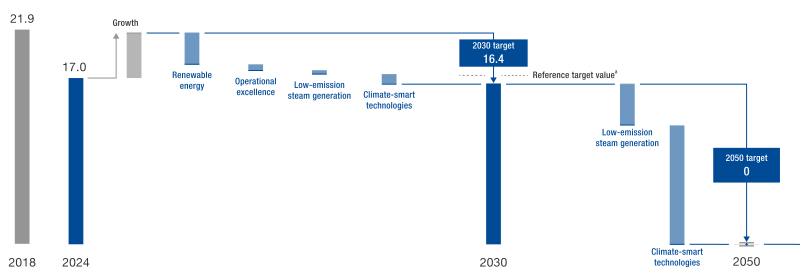
Roughly half of BASF’s Scope 1 and Scope 2 emissions are attributable to energy produced to operate our plants. Scope 2 emissions can be reduced by up to 3.2 million metric tons of CO2 by 2030 using the “renewable energy” lever. Additional emission reductions of up to 0.6 million metric tons of CO2 (Scope 1) are possible in the period up to 2030 using the “low-emission steam generation” lever. In the long term, new steam generation technologies such as heat pumps and e-boilers not only enable emission reduction but will also enable decoupling of highly efficient steam and power generation in combined heat and power plants. The electricity generated from this today can then also be provided using renewable energy. The other half of our Scope 1 and Scope 2 emissions arise in our production processes. One way of reducing these emissions is the continuous improvement of our plants (operational excellence). We see a reduction potential of up to 0.6 million metric tons of CO2 (primarily Scope 1), which we aim to achieve by 2030. Furthermore, we are working to develop and implement climate-smart technologies so as to facilitate lower-emission production. This results in a further reduction potential of up to 1.1 million metric tons of CO2 (Scope 1) by 2030. Our emission reduction levers enable the reduction of growth-related CO2 emissions that will be added by 2030, which are associated with organic growth and the investment in our new Verbund site in southern China. All reduction measures implemented are to be regarded as long-term. We will counteract growth-driven emission increases between 2030 and 2050 primarily using the “climate-smart technologies” and “low-emission steam generation” levers.
The transition plan reflects the market-driven transformation approach set out in our “Winning Ways” strategy, in which we have adopted a step-by-step approach (see also Strategy and Governance). For the progress made in implementing our transition plan, clustered by the relevant emission reduction levers, see section Actions. We continuously evaluate and prioritize specific actions for emission reduction and target achievement from an economic and technological perspective. We also continuously analyze our portfolio. Consequently, the representation in the graphic depicts the current status of our planning at the time of the publication of the transition plan at the beginning of 2025, but is subject to future updates. We will only consider external offsetting measures for our Scope 1 and Scope 2 emissions14 as a temporary measure in the medium term if our activities were not to make the desired contribution to reducing emissions.
As an energy- and emissions-intensive sector, the chemical industry today has a significant amount of potential locked-in greenhouse gas emissions.15 This also applies to BASF and was taken into account when assessing our emission reduction levers. Since significant financial resources will be needed to transform our plants, locked-in emissions from assets jeopardize the achievement of our targets in principle. Potential locked-in emissions are factored into our investment decisions, such as the plans for our new Verbund site in southern China. From start of commissioning in 2025 onward, the latter is already supplied exclusively with electricity from renewable sources and shall serve as a model for more sustainable chemical production.
Few of our products lead directly to CO2 emissions during their use phase. Nevertheless, we also aim to further reduce these emissions by constantly looking for new, more sustainable solutions (see Our Product Carbon Footprints) and have already achieved significant emission reductions as a result (see the reduction in Scope 3.11 in section Actions along our value chain).
The transition plan is embedded in our financial planning and was approved by the Board of Executive Directors and the Supervisory Board. It is based on investments of around €0.6 billion in Scope 1 measures between 2026 and 2029. These are part of BASF's green transformation expenditures of an expected €1.2 billion between 2026 and 2029. In line with our market-oriented approach and the reduced speed of industrial feedstock transformation, we have adjusted our investments. We aim to continue to promote the use of renewable energies with long-term supply agreements.
In 2025, we invested €77 million, which was attributable to gas-related economic activity (see tables in EU Taxonomy chapter). In addition to investments made to achieve our emission reduction target, we have also invested in steam generation at the site in Zhanjiang, China. A small part of steam generation there will come from a boiler fired using natural gas, among other things, alongside the future use of process waste heat steam. In addition, there were no significant taxonomy-aligned investments/capex with respect to the environmental objectives of climate change mitigation and climate change adaptation. The low coverage of BASF’s activities in the EU taxonomy and the reporting criteria currently used, at present provide a picture of BASF’s potential sustainability contribution that is only of limited informative value. The small number of activities that fall under the climate change mitigation environmental objective are presented under EU Taxonomy. Hence, BASF is not pursuing any further plans to align economic activities with the provisions of Delegated Regulation (EU) 2021/2139.
Responsibility in our value chain
ESRS-Kennzeichnung:
We are focusing on procurement-specific actions to reduce our raw materials-related emissions (Scope 3.1) and are working closely together with our suppliers (see Actions along our value chain). In recent years, we have been able to considerably increase the data availability and thereby the transparency of our raw materials-related emissions, and aim to steer these more precisely via our associated Scope 3.1 target. What is more, we are taking responsibility for our other emissions along the value chain (see Actions along our value chain). Reducing Scope 3 emissions – which account for the majority of our total emissions – presents us with particular challenges, as these are only partly within our own direct sphere of influence and are subject to a large number of external factors.
We are also increasingly focusing on circularity in the form of renewable and recycled raw materials and raw materials based on the use of CO2 in order to move from linear value creation to closed-loop material cycles (see E5 Resource Use and Circular Economy). In the future, we will increasingly drive forward sourcing of renewable raw materials and deploy a make & buy approach analogous to that with which we source renewable energy. Feeding in greater amounts of renewable, recycled and low-emission raw materials in our existing plants will allow us to leverage the unique advantages of our Verbund and to offer our customers products with lower PCFs.
We use a digital solution that continuously determines the PCFs of our products16 (see Our Product Carbon Footprints) to increase transparency about our product-specific greenhouse gas emissions and focus CO2 reduction measures on those areas where they bring the greatest added value. These PCFs include all greenhouse gas emissions – from raw materials extraction to the finished product leaving the factory gates (cradle-to-gate). This lets our customers benefit from lower CO2 emissions in the value chain. In addition, we offer our customers solutions that help prevent greenhouse gas emissions and improve energy and resource efficiency.
Moreover, our TripleS method for steering the sustainability performance of our product portfolio is a material element in the process of enhancing transformation topics relating to climate change, energy, resource efficiency and the circular economy (for more information, see General Disclosures and our resilience and scenario analyses). In addition to implementing new regulatory requirements, we are driving forward the adaptation and development of new production processes with the aim of reducing the environmental footprint of our products. Criteria for reducing CO2 emissions are a key part of the evaluation process.
All parts of society must work together to effectively protect the climate. The basis is a political and regulatory environment that promotes innovation in climate protection, makes it possible to develop new processes that are competitive internationally and resolutely drives forward the expansion of renewable energies. Our aim is to contribute to shaping the transformation toward climate neutrality in a socially just manner (just transition). We include the viewpoints of our external stakeholders in our decisions and actions using dialog forums and advisory councils such as the Nature Advisory Council, which we established together with external experts (for more information, see General Disclosures). Together with Vulcan Energy, for example, we provided information about the current status and next steps of the geothermal project in Ludwigshafen and the Vorderpfalz region in community townhall events in 2025 (for more information, see Low-emission steam generation). The Civil Society Forum, founded in 2024, also provides space for confidential exchange with representatives of the civil society and trade union spectrum (for more information, see General Disclosures).
In addition, we support various national and international initiatives and are involved in partnerships. For example, we engaged in close dialog with the Science Based Targets initiative (SBTi), which has derived science-based climate protection targets for the chemical sector.
We are committed to reporting transparently on our climate protection targets and progress, as well as on the impacts of climate change on BASF. In this context, we support the recommendations of the Task Force on Climate-related Financial Disclosures (TCFD). We have also participated in the program established by the international nonprofit organization CDP for reporting on data relevant to climate protection since 2004. BASF achieved a score of A in CDP’s 2025 climate change questionnaire, again attaining Leadership level. Companies at Leadership level are distinguished by factors such as the completeness and transparency of their reporting.
6 Target-relevant Scope 1 and Scope 2 emissions (excluding the sale of energy to third parties). Greenhouse gases according to the Greenhouse Gas Protocol, converted into CO2 equivalents (CO2e).
7 The exact percentage influence on compensation depends on target achievement. For more information, see the Compensation Report, which will be publicly available at basf.com/compensationreport.
8 Scope 1 and Scope 2 (excluding the sale of energy to third parties). Greenhouse gases according to the Greenhouse Gas Protocol, converted into CO2 equivalents (CO2e).
9 The IEA’s Net Zero by 2050 study reflects a scenario that, measured in accordance with the IPCC Special Report on Global Warming of 1.5°C, is consistent with a 1.5°C scenario for 2030 with a low temperature overshoot and with a 1.5°C scenario in which there is no overshoot for 2050.
10 Important raw materials such as ethylene, propylene, benzene, toluene and mixed xylenes
11 Scope 3.1, gross emissions from raw materials excluding battery materials, excluding services, technical goods and greenhouse gas emissions from BASF trading business. The emissions account for 52% of total Scope 3 emissions based on the 2025 business year.
12 BASF is not an undertaking that is excluded from the EU Paris-aligned Benchmarks in accordance with the exclusion criteria stated in Article 12(1), points (d) to (g) of Commission Delegated Regulation (EU) 2020/1818 (Climate Benchmark Standards Regulation).
13 No climate scenarios were used to identify the levers. Instead, the levers are based on an analysis of the sources of emissions and the technical means of reducing them.
14 Scope 1 and Scope 2 (excluding the sale of energy to third parties). The emissions account for 96% of total Scope 1 and Scope 2 emissions in relation to the base year. Greenhouse gases according to the Greenhouse Gas Protocol, converted into CO2 equivalents (CO2e).
15 These are future greenhouse gas emissions that are likely to be caused by key assets or products within their operating lifetimes.
16 This includes all BASF products of all A companies and some selected B companies, excluding traded goods. For more information on the Group’s legal structure, see BASF Group.
Actions
ESRS-Kennzeichnung:
We consistently align our actions with our climate protection targets, based on a comprehensive analysis of our emissions. The transformation of our company toward a low-emission chemistry is closely linked to our customers’ transformation (see also Strategy and Governance).
No significant capital and operating expenses within the meaning of the EU taxonomy were incurred in the business year 2025 for the actions described.
Renewable energy
Roughly half of our Scope 1 and Scope 2 emissions are attributable to our plants’ energy demand. A core component is therefore converting our energy supply from fossil to renewable sources; this applies especially to our electricity supply. In 2025, electricity from renewable sources as a share of total electricity consumption rose further compared with the previous year to 36% (2024: 26%). Our electricity consumption will increase significantly in future due to the planned gradual electrification of our steam generation and the switch from natural gas-based to electricity-based, low-emission production processes.
As regards the transformation of our electricity supply, we are pursuing a make & buy approach in the short, medium and long term. On the one hand, BASF is investing in its own renewable power assets. On the other hand, we are focusing on purchasing green electricity on the market through long-term supply agreements with plant operators, green electricity purchase agreements or renewable energy certificates, depending on the region and market regulations.
In 2025, we further advanced the supply of electricity from renewable sources. Our new Verbund site in Zhanjiang in southern China, where we started manufacturing the first products from the Verbund in November 2025, is powered entirely with electricity from renewable sources. A joint venture was established for this purpose with the Mingyang Wind Power Group Limited, which includes the development, construction and operation of an offshore wind farm in Zhanjiang. The wind farm is under construction and has a planned capacity of 500 megawatts. The grid connection project has been successfully completed and the wind farm is scheduled to start operation in 2026.
Since the beginning of the 2025 business year, our Zhanjiang site has already been supplied with 100% electricity from renewable sources through a supply agreement with the State Power Investment Corporation (SPIC). In addition to the existing long-term supply agreements with the SPIC, we have entered into a supply agreement with China Energy Engineering Group Guangdong Electric Power Design Institute (GEDI) to source electricity from renewable sources over a period of 25 years. We also made progress at other Asian sites in 2025: Six of our production sites in Shanghai will be supplied with 250 gigawatt hours of electricity from renewable sources via China Huaneng Group in the future. This agreement also includes the first ever cross-business-zone17 electricity supply agreement for electricity from renewable sources from the Chinese provinces of Guangxi and Yunnan to Shanghai. BASF Taiwan has also taken another step toward energy transition. Our Kuanyin site had already participated in the first green electricity auction held by Taiwan Power Company (Taipower), Taiwan’s largest electricity supplier, in 2023 and had won the bid of a small amount of renewable energy for three years. In 2025, the Changhua site was also successful in a similar auction.
In spring 2025, we signed an agreement with SP Group (Singapore Power) to install solar rooftop panels at two of our production sites in Singapore. In 2023 and 2024, we had already signed long-term power purchase agreements for electricity from renewable sources at our three sites in Jiangsu, China, and for six of our production sites in Korea.
The Hollandse Kust Zuid offshore wind farm, a joint project with Vattenfall and Allianz, has been operational since the summer of 2024. With 139 turbines and a capacity of 1.5 gigawatts, it is one of the largest subsidy-free offshore wind farms in the world. We use the electricity generated to supply our production sites in Europe, particularly Ludwigshafen, Germany.
In North America, we were able to secure around 150 megawatts of solar generation capacity through virtual power purchase agreements back in 2022. These solar power plants are already operational. Further long-term supply agreements exist with X-ELIO, providing capacity of 48 megawatts of solar power to supply the Freeport, Texas site (Liberty project) and with other developers, providing 33 megawatts of solar power for the Freeport site and 35 megawatts of wind energy for the Freeport and Pasadena sites in Texas. With the Liberty project, which went into operation in 2025, the purchased electricity for our Verbund site in Freeport will come from 100% renewable energy sources. In some regions, we have also acquired renewable energy certificates. In addition, at the end of 2025, BASF concluded an agreement with BP Energy Retail Company for the purchase of renewable energy certificates. The 15-year agreement covers a wind capacity of approximately 47 megawatts.
The carbon footprint of purchased electricity in 2025 was around 0.14 metric tons of CO2 per MWh (market-based approach) (2024: 0.20 metric tons of CO2 per MWh). For the 2025 business year, by using electricity from renewable sources, we were able to reduce our greenhouse gas emissions by around 1.5 million metric tons of CO2 compared to the use of electricity from fossil sources (for more information on the expected emission reductions, see our transition plan).
In order to align the supply of green electricity with the decreased transformation speed, BASF sold its 49% stake in the Nordlicht 1 and 2 offshore wind farms back to Vattenfall in 2025. This transaction is in line with BASF’s disciplined approach to capital allocation, as well as BASF’s market-driven, step-by-step transformation approach as part of the “Winning Ways” strategy. At the same time, BASF continues its collaboration with Vattenfall, securing a long-term supply of electricity from renewable sources for chemical production in Europe – at a time when additional green electricity will be needed.
Operational excellence
Through our operational excellence projects, we aim to operate our plants even more efficiently, to make our processes even more resource-saving and thereby reducing CO2 emissions. Certified energy management systems according to DIN EN ISO 50001 at all relevant production sites play a particularly important role here.18 These help us to continuously identify and implement potential for improvement in energy efficiency. This not only reduces greenhouse gas emissions and saves valuable energy resources but also increases our competitiveness.
In 2025, we implemented more than 550 measures to reduce energy and resource consumption and increase our competitiveness, which led to a reduction in emissions of around 240,000 metric tons of CO2 (for more information on the expected emission reductions, see our transition plan). In Hannibal, Missouri, for example, natural gas consumption has been reduced by optimizing process control at our incinerators, resulting in an annual CO2 reduction of about 7,000 metric tons. In Camaçari, Brazil, we have achieved a reduction in steam consumption by optimizing the valve seals and pipeline layout in one plant, avoiding around 6,700 metric tons of CO2 emissions annually. At the Caojing site in China, the consumption of natural gas in one plant was significantly reduced by making full use of surplus hydrogen from a third-party company and developing a timely signal transmission system for hydrogen supply in collaboration with the supplier. Together, these actions reduce CO2 emissions by around 9,600 metric tons per year.
Low-emission steam generation
Alongside electricity, steam generation is an important component of our energy supply. In the medium to long term, new technologies should make a significant contribution to reducing CO2, for example by recovering energy from waste heat in our production and infrastructure facilities. In this context, we are examining various concepts such as using electric heat pumps and e-boilers as well as electrifying steam drives. We have already made initial progress toward low-emission steam generation: In 2024, BASF received funding approval from the German Federal Ministry for Economic Affairs and Climate Action for constructing the world’s largest industrial heat pump for emission-free steam generation at its site in Ludwigshafen, Germany. Construction began in 2025. The heat pump will have a capacity of up to 500,000 metric tons of steam per year. The waste heat, which is used as a thermal energy source, is generated during the cooling and cleaning of process gases in one of the two steam crackers at the site. Emission-free steam is generated using electricity from renewable sources and is primarily to be used for producing formic acid. This offers the potential to use the heat pump to reduce CO2 emissions related to the production by up to 98%. A smaller proportion of the emission-free steam is supplied to other BASF production plants via the steam network at the site. In total, the heat pump, which is scheduled to start operation in 2027, will save up to 100,000 metric tons of CO2 per year at the company’s headquarters. The expansion of the substation at the Ludwigshafen site by the transmission system operator Amprion began in 2025 in order to take account of the future increase in electricity demand due to the electrification of chemical production and energy generation processes, such as low-emission steam generation. Initial partial commissioning is planned from 2029 onward, with overall completion scheduled until 2037.
We are also examining the use of geothermal energy at the Ludwigshafen site as part of a partnership with Vulcan Energy. The results of initial 2D seismic evaluations carried out by our partner in the Vorderpfalz region in spring 2025 confirm the region’s geothermal potential. Further measurements, including a 3D seismic evaluation, are planned. Geothermal energy from the Vorderpfalz region could be used by heat pumps to generate emission-free steam. With a potential output of 300 megawatts of thermal energy, around 4 million metric tons of this crucial energy source for the chemical industry could be produced per year. This would avoid roughly 800,000 metric tons of CO2 emissions. The overarching goal of BASF and Vulcan Energy is to implement the joint geothermal project in the early 2030s.
We are also focusing on low-emission steam generation at our site in Schwarzheide, Germany. The goal there is to construct and operate a power-to-heat plant together with transmission systems operator 50Hertz. The plant will convert electricity from renewable sources into process heat. The planned plant consists of a 25-megawatt electrode boiler and is scheduled to start operation at the end of 2026. Another power-to-heat plant is currently being built at the Guaratinguetá site in Brazil. It is scheduled for startup by the end of 2026. The plant will be powered by electricity from renewable energy sources, so that in the future up to 60% of the steam demand on site can be provided with low emissions.
Climate-smart technologies
To further abate CO2 emissions, we are also developing completely new technologies for emission-free and low-emission production and are planning to scale them as far as possible from 2030 onward. The main focus here is on basic chemicals, which are often still emission-intensive to produce. This is the case with steam crackers, for example, which use high temperatures of 850°C to break down crude petroleum into olefins and aromatics. The high temperatures have until now been achieved by burning natural gas. A heating concept using electricity from renewable sources could reduce process-related emissions by at least 90% in future compared to today’s conventional technologies. Together with our partners SABIC and Linde, we are testing this new process on an industrial scale, as well as the associated direct and indirect heating concepts, in a demonstration plant for electrically heated steam cracker furnaces at our site in Ludwigshafen, Germany.19 The prototype is completely integrated into one of the two existing steam crackers at the site.
One common but emission-intensive way of obtaining hydrogen is steam reforming. We are testing an alternative process – methane pyrolysis – in Ludwigshafen, Germany. This process is virtually emission-free if renewable energy is used and requires considerably less electricity compared with other methods such as water electrolysis. We successfully tested a new reactor concept at the test plant, which was commissioned in 2021, and demonstrated stable operations. In November 2025, we agreed on a collaboration with ExxonMobil to jointly advance methane pyrolysis technology to commercial readiness. In Baytown, Texas, we are planning to construct and operate a joint demonstration plant intended to help validate the technology at scale.
Together with Siemens Energy, we also pressed ahead with the construction of a proton exchange membrane (PEM) water electrolyzer20 with a capacity of 54 megawatts at the Ludwigshafen site in Germany. The plant went into operation in March 2025. Powered by electricity from renewable energy sources, the electrolyzer produces up to 8,000 metric tons of emission-free hydrogen and thus reduces greenhouse gas emissions at the site by up to 72,000 metric tons per year. BASF will primarily use the hydrogen produced as a raw material for the manufacture of products with a reduced PCF. We also agreed a partnership with Envision Energy, a leading provider of sustainable technologies, at the beginning of 2024. The objective is to drive forward the conversion of green hydrogen and CO2 into e-methanol, as sustainable energy carrier. BASF is contributing its catalyst technologies expertise. In addition, we are expecting new hydrogen applications to emerge in the future, such as its use as an independent or a basic material for sustainable energy carriers, and that demand for hydrogen is likely to increase as a result. Access to large quantities of low-emission or emission-free hydrogen at competitive costs is therefore becoming increasingly important for BASF.
Another focus area of our technological development is carbon capture and storage (CCS). This technology is expected to be one of the most economically attractive ways to reduce hard to abate emissions in the medium and long term. For this reason we are examining the implementation of CCS plants at various locations worldwide.
Actions along our value chain
As part of our supplier management, we continuously review compliance with our required criteria when selecting suppliers and evaluating supplier relationships. We urge our suppliers to reduce CO2 emissions. We arrange for third parties to evaluate suppliers with a high sustainability risk using either on-site audits or sustainability assessments by rating agency EcoVadis. Supplier evaluation is mainly performed as part of the chemical industry’s Together for Sustainability initiative. Depending on business requirements, we perform our own Responsible Care audits at selected contract manufacturers if material risks have been identified with respect to environmental protection. This also includes the topic of CO2 emissions.
We launched the Supplier CO2 Management Program in 2021 to achieve transparency with respect to our raw materials-related emissions. The goal is to obtain a more accurate data base and to better manage and reduce emissions in the supply chain. In a first step, we have since requested the PCFs of our raw materials and support our suppliers in determining these, for example, by sharing our knowledge of valuation and calculation methods with them. After around four years, we have more than 2,200 validated PCFs. This corresponds to a coverage of 40% in relation to the greenhouse gas emissions of our raw materials. We are working to further increase the transparency of the PCFs of our raw materials and thus the quality of the PCFs of our products.
In addition, we launched the next phase of our Supplier CO2 Management Program already in 2024, so as to agree PCF reduction pathways with our suppliers. We use dialog forums to exchange information with suppliers about opportunities, challenges and BASF’s specific expectations regarding PCF reductions. One example are the BASF Supplier Days that were held on the topic of Scope 3.1 emissions in 2025 in Houston, Texas for the North America region and in Shanghai, China for the Asia Pacific region. The format had already been rolled out in the Europe and South America regions in 2024. We are also enhancing our purchasing processes and establishing PCFs as a relevant criterion for raw materials in the procurement requirements.
Natural gas – in particular low-carbon natural gas – remains a key energy source and raw material for BASF on the path to climate neutrality. In this context, we are focusing on new supply agreements that balance security of supply, flexibility and climate compatibility. In June 2025, BASF and Norwegian energy company Equinor signed a long-term strategic agreement for the annual delivery of up to 23 terawatt hours (around 2 billion cubic meters) of natural gas over a period of ten years. Norwegian natural gas has a carbon footprint less than half the size of the European gas market average, because, among other things, very little methane escapes during its production and processing and predominantly renewable electricity is used. Delivery began on October 1, 2025.
To replace fossil raw materials, we concluded a long-term purchase agreement for certified biomethane with ENGIE in 2024. This is used at our Verbund sites in Antwerp, Belgium, and Ludwigshafen, Germany. Consequently, we are able to reduce the carbon footprint of sales products in sectors such as the automotive, packaging and detergent industries using our mass balance approach. In another project with raw material supplier Graphit Kropfmühl, we agreed on an innovative approach to reducing the carbon footprint of its products. We supply the company with Guarantees of Origin for electricity from renewable sources, reducing the PCF of the graphite produced. We then use the graphite as a raw material to reduce the PCF of our insulation material Neopor®. Together with AkzoNobel and Arkema, BASF is working to lower the carbon footprint of architectural powder coatings supplied by AkzoNobel’s Interpon brand. To this end, BASF supplies neopentyl glycol (NPG) with a PCF of zero to its partner Arkema, which in turn transforms the bio-attributed raw materials and thus reduces the carbon footprint of super-durable powder coating resins for AkzoNobel.
In Taiwan, BASF has signed a license agreement with Carbon Cap Applications Technology Co. (CCAT) to provide its OASE® blue gas treatment technology for a carbon capture and storage project at a power plant belonging to the Taiwan Power Company (Taipower) in the Taichung Power Plant Carbon Reduction Technology Park. The project is operated by Taipower and, according to design and planning requirements, is expected to capture 2,000 metric tons of CO2 annually. BASF and the ANDRITZ Group have signed a license agreement for the use of OASE® blue in a carbon capture project planned to be implemented in Aarhus, Denmark. The project aims to capture around 435,000 metric tons of CO2 annually from the flue gases of a waste-to-energy plant for sequestration. The implementation of the project is contingent upon the customer receiving funding from the Danish CCS fund.
In addition to reducing our raw materials-related emissions (Scope 3.1), we are taking targeted measures to reduce Scope 3 emissions along the entire value chain. To reduce the emissions from transporting our products (Scope 3.9), the Monomers division has developed a shipment emissions dashboard that enables us to share standardized, reliable data on shipment-related emissions with our customers and identify the most sustainable means of transportation. Moreover, we rely on product adaptations to reduce emissions from the use of sold products (Scope 3.11): For example, climate-damaging blowing agents for foaming polyurethane foams can now be largely dispensed within the downstream value chain. Thanks to these and other measures, we have been able to reduce our emissions from the use of sold products (Scope 3.11) by around 75% since 2018.21 We also want to reduce emissions resulting from the disposal of our products (Scope 3.12). This can be done, for example, through the increased use of renewable raw materials or circular solutions (see E5 Resource Use and Circular Economy). Both ensure that less and less CO2 pollutes the atmosphere throughout the life cycle of our products.
Our Product Carbon Footprints
In 2025, we further expanded our product portfolio with a certified reduced carbon footprint, for example in aroma ingredients through the market launch of L-menthol FCC rPCF, in ammonia products, or with our Basotect® EcoBalanced melamine resin foam for sound absorption applications in the transportation and construction industries. The Intermediates division has switched its amine portfolio at our BASF sites worldwide to 100% renewable electricity. In 2025, this transition took place at the European Verbund sites in Ludwigshafen and Antwerp, Belgium as well as the Verbund site in Geismar, Louisiana. At BASF’s Nanjing site in China, amine production had already switched to renewable electricity in 2023. In addition, we are counting on acrylic monomers produced with electricity from renewable energies that can be used by customers in adhesive products, for example. With biomass-balanced polyethersulfone (PESU), we have been offering our customers a more sustainable alternative in high-performance plastics for industries such as household, automotive, electrics and electronics since the beginning of 2025. We already offer net-zero carbon footprint versions of some of our products, including the polyamide Ultramid® and the HySorb® superabsorbent for the hygiene industry, as Ultramid® ZeroPCF and HySorb® B 6610 ZeroPCF. These lower PCFs are primarily made possible by the substitution of fossil raw materials. For example, we use partially or fully renewable, waste-based or recycled raw materials to produce lowPCF and zeroPCF products. These include castor oil, biomethane or pyrolysis oil from plastic waste. These alternative resources often have a lower carbon footprint compared with fossil raw materials. The alternative resources are allocated to the end product using the mass balance approach. Furthermore, we use electricity and steam from renewable sources to reduce our PCFs.
The digital methodology we have developed to calculate PCFs meets general life cycle analysis standards such as ISO 14040, ISO 14044 and ISO 14067, as well as the Greenhouse Gas Protocol Product Standard. A certification from TÜV Rheinland confirms that our calculation method and our reporting fully comply with the requirements of Together for Sustainability (TfS). We make our automated PCF calculation approach available to interested industry players through partnerships. We are involved in various initiatives to drive transparency, harmonization and standardization across the industry. This also takes place as part of TfS, where we have been involved in the creation and revision of a uniform guideline for calculating the carbon footprint of products in the chemical industry. This enables the climate impacts of products to be directly compared and evaluated based on a standardized approach. Harmonizing the approaches used to calculate PCFs allows us to better steer CO2 emissions that arise during the extraction of raw materials or the manufacture of precursors. A digital solution developed by TfS and Siemens for exchanging PCF data between companies was launched in October 2024. We have fully migrated our queries to this solution since mid-2025. Equally, it has been possible to exchange data within the Catena-X network, in which we work together with partners in the automotive value chain, since 2024.
17 “Cross-business zone” here means that electricity from renewable energies generated in other Chinese provinces (e.g. in Guangxi or Yunnan) is used to supply production facilities in Shanghai.
18 Relevant sites are selected based on the amount of primary energy used and local energy prices.
19 The project has been granted €14.8 million from Germany’s Federal Ministry for Economic Affairs and Climate Action (BMWE) under the Decarbonization in Industry funding program. It is also being financed by the European Union via the NextGenerationEU fund.
20 The project is funded by Germany’s Federal Ministry for Economic Affairs and Climate Action (BMWE) and the Federal State of Rhineland-Palatinate.
21 BASF operations without oil and gas business
Global Targets
ESRS-Kennzeichnung:
As an energy-intensive company that generates and consumes energy in the form of electricity and steam and that processes fossil raw materials, we are responsible for greenhouse gas emissions that negatively impact the climate (see also Impacts, risks and opportunities from our business activities). We accept this responsibility and are pursuing ambitious climate protection targets.22
Scope 1 and 2
Based on the 2018 base year, we want to achieve a 25% reduction in greenhouse gas emissions from our production processes (Scope 1) and our energy purchases (Scope 2) by 2030.23 Our target focuses on emissions caused by our production and includes 96% of our gross Scope 1 emissions and 99% of our gross Scope 2 emissions. This means that in the period 2018 to 2030 we aim to reduce annual greenhouse gas emissions from 21.9 million metric tons to 16.4 million metric tons – despite our growth plans and the construction of a new Verbund site in southern China. This corresponds to a decrease of around 60% compared with 1990. Our long-term target is to achieve net-zero greenhouse gas emissions by 2050.23 In line with the requirements of the Greenhouse Gas Protocol, we consider future developments in our Scope 1 and Scope 2 emissions in the event of changes to our corporate structure. When recalculating the emissions from the base year, we have set ourselves a limit of 5% cumulative deviations from the base year.
Greenhouse gas emissions of the BASF Group (Scope 1 and 2)a
million metric tons of CO2 equivalents
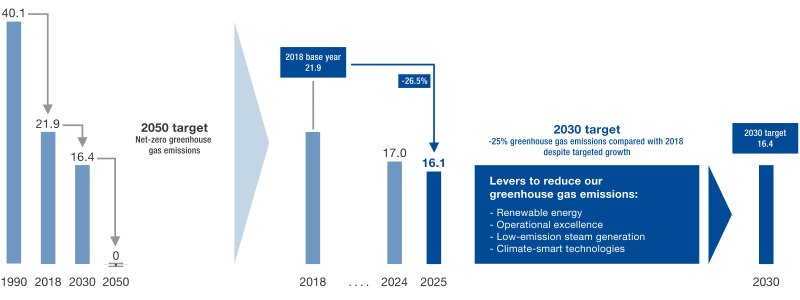
In 2025, the BASF Group’s emissions from production and energy purchases amounted to 16.1 million metric tons of CO2 equivalents (2024: 17.0 million metric tons of CO2 equivalents). We further increased the share of electricity from renewable sources to 36% and, together with measures to increase energy and process efficiency, made a relevant contribution to reducing emissions. Furthermore, the decline in demand year on year led to a reduction in production volumes and thus lower CO2 emissions. All in all, we have reduced our greenhouse gas emissions in BASF’s operations by 60% since 1990. In the coming year 2026, we expect significant additional emissions from our recently commissioned Verbund site in Zhanjiang, China. These have already been taken into account when setting targets. Our projection of target-relevant Scope 1 and Scope 2 emissions for 2026 can be found in the forecast.
Scope 3.1
We set ourselves an ambitious Scope 3.1 target24 for our specific raw materials-related emissions in 2023. This includes around 92% of our Scope 3.1 emissions based on the base year. By 2030, we want to reduce these in relation to the purchasing volume specifically by 15% from the 2022 base year. In this way, we aim to reduce our specific Scope 3.1 emissions from 1.64 kilograms of CO2 per kilogram of purchased raw material in the base year 2022 to 1.39 kilograms of CO2 per kilogram of purchased raw material in the target year 2030. Through our commitment, we aim to keep our target-relevant Scope 3.1 emissions at roughly constant 50 million metric tons of CO2 equivalents by 2030 while at the same time growing production.
Raw materials-related emissions from battery materials are initially excluded from the target. Battery materials make a significant contribution to reducing CO2 emissions and thus facilitate the transformation of the transportation sector. Required raw materials such as lithium, nickel and cobalt will not be able to be replaced by more sustainable alternatives in the foreseeable future. Accordingly, associated emissions cannot be reduced significantly in the short term. As soon as recyclable solutions come into play with the increase in available end-of-life batteries, we will include these raw materials in our target definition (for more information on our battery recycling activities, see E5 Resource Use and Circular Economy).
In the long term, we are striving to reduce Scope 3.1 emissions to an unavoidable minimum by 2050, thereby expanding our long-term net-zero target to include these greenhouse gas emissions.
Greenhouse gas emissions of the BASF Group (Scope 3.1)
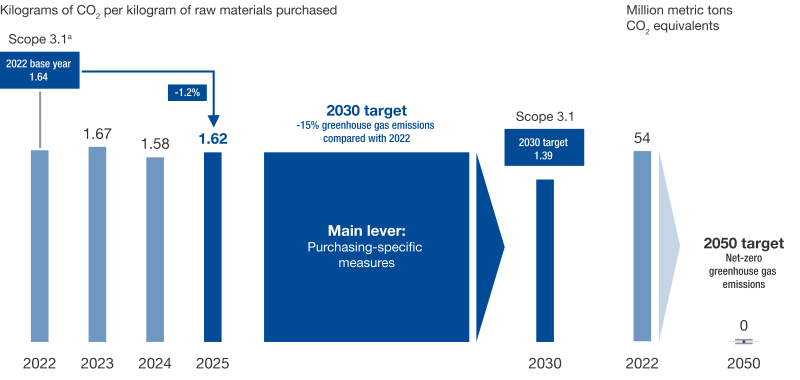
In 2025, specific Scope 3.1 emissions25 amounted to 1.62 kilograms of CO2 per kilogram of raw materials purchased (2024: 1.58 kilograms of CO2 per kilogram of purchased raw material). The increase in specific emissions was mainly attributable to a change in the raw materials portfolio. This was countered by initial purchases from suppliers who offer raw materials with a lower PCF.
We monitor progress toward our targets annually as part of our strategic controlling activities. For an overview of our greenhouse gas emissions – broken down by operational control and financial control – see BASF Group’s greenhouse gas emissions according to the Greenhouse Gas Protocol.
Target setting was preceded by an analysis of expected business developments, external requirements relating to emission reduction targets and internal implementation opportunities, including the use of pilot plants to develop technical solutions. In addition, cost estimates were developed for planned actions. A Supplier CO2 Management Program was established and support was provided for the development of standards such as TfS before the Scope 3.1 target was introduced. This approach was designed to ensure that the targets were not only ambitious but also implementable. We discuss the sustainability topics that are material for BASF at regular meetings with external stakeholders as part of our strategic stakeholder engagement as well as in meetings with investors. In this way, stakeholder expectations are continuously taken into account in the development of strategic approaches, targets and principles of sustainability management.
Carbon credits
ESRS-Kennzeichnung:
As part of the above stated targets, we aim to reduce our Scope 1, 2 and 3.1 emissions to net zero by 2050. Despite all our efforts, we expect there to be a residual share of emissions in 2050 that cannot be abated using technical or economic approaches. We aim to neutralize all remaining emissions elsewhere through measures that are characterized by high quality and credibility. These include nature-based measures such as reforestation, but also technical possibilities such as the long-term storage of originally biogenic carbon. We plan to use ratings from carbon credit rating agencies such as BeZero and Sylvera to assess the quality of carbon credits. We also plan to leverage initiatives such as the Integrity Council for the Voluntary Carbon Market (ICVCM), its Core Carbon Principles, and the credits assessed through them. We are developing internal standards for evaluating climate protection projects and considering whether to develop our own projects. We are also investigating the use/development of a project under the European Carbon Removal and Carbon Farming Certification Framework (CRCF). With these conditions in mind, we anticipate using a portfolio of different credits. Our focus is on credits that meet well-established standards such as Verra or Gold Standard, but also on certificates that are created under Article 6 of the Paris Agreement or that rely on the CRCF. BASF did not use any carbon credits in the past business year.
22 We report on greenhouse gas emissions in accordance with the Greenhouse Gas Protocol Standard as well as the sector-specific standard for the chemical industry. Our targets include future organic growth and investments that in turn increase the level of emissions to be reduced. A linear correlation between emissions and production volumes was assumed for the purpose of estimating additional emissions. Our targets are based on the scope of consolidation using the financial control method and are audited in the context of the annual report. For information on compatibility with the 1.5°C scenario, see Transition plan for climate change mitigation.
23 Scope 1 and Scope 2 (excluding the sale of energy to third parties). The emissions account for 96% of total Scope 1 and Scope 2 emissions in relation to the base year. The target includes greenhouse gases according to the Greenhouse Gas Protocol, which are converted into CO2 equivalents (CO2e). Scope 2 emissions are calculated using the market-based approach in accordance with the Greenhouse Gas Protocol. Based on the aforementioned emission reduction levers, we assume a reduction in Scope 1 emissions of around 14% between 2018 and 2030. We aim to reduce Scope 2 emissions by around 75% in the same period. The target is aligned with limiting global warming to a global average of 1.5°C, and is thus science-based. It has not been externally audited.
24 Scope 3.1, gross emissions from raw materials excluding battery materials, excluding services, technical goods and greenhouse gas emissions from BASF trading business. The emissions account for 52% of total Scope 3 emissions based on the 2025 business year. The target is not science-based and has not been externally audited.
25 Scope 3.1, raw materials excluding battery materials, excluding services, technical goods and greenhouse gas emissions from BASF trading business.
Metrics
Energy supply
ESRS-Kennzeichnung:
Our total energy consumption in 2025 amounted to 74.3 million MWh (2024: 74.8 million MWh).26 Total energy consumption includes fuel demand for our own energy generation and production plants, plus power and steam imports for our own use.
|
|
2025 |
2024 |
|||||||||||||||||||||||||||||||||||||||||||||
|---|---|---|---|---|---|---|---|---|---|---|---|---|---|---|---|---|---|---|---|---|---|---|---|---|---|---|---|---|---|---|---|---|---|---|---|---|---|---|---|---|---|---|---|---|---|---|---|---|
Million MWh |
|
Financial control |
Operational controla |
Financial control |
Operational controla |
|||||||||||||||||||||||||||||||||||||||||||
Total energy consumptionb |
|
74.3 |
73.5 |
74.8c |
74.1c |
|||||||||||||||||||||||||||||||||||||||||||
|
|
|
|
|
|
|||||||||||||||||||||||||||||||||||||||||||
|
|
|
|
|
|
|||||||||||||||||||||||||||||||||||||||||||
Fuel consumption from renewable sources (biomass) |
|
0.0 |
0.0 |
0.0 |
0.0 |
|||||||||||||||||||||||||||||||||||||||||||
Consumption of purchased or acquired electricity, heat, steam, and cooling from renewable sources |
|
5.1 |
5.2 |
3.6 |
3.6 |
|||||||||||||||||||||||||||||||||||||||||||
Consumption of self-generated nonfuel |
|
0.0 |
0.0 |
0.0 |
0.0 |
|||||||||||||||||||||||||||||||||||||||||||
Total energy consumption from renewable sources |
|
5.2 |
5.2 |
3.6 |
3.6 |
|||||||||||||||||||||||||||||||||||||||||||
Share of renewable sources in total energy consumption |
% |
6.9 |
7.1 |
4.8 |
4.9c |
|||||||||||||||||||||||||||||||||||||||||||
|
|
|
|
|
|
|||||||||||||||||||||||||||||||||||||||||||
|
|
|
|
|
|
|||||||||||||||||||||||||||||||||||||||||||
Fuel consumption from coal and coal products |
|
1.0 |
1.0 |
1.1 |
1.1 |
|||||||||||||||||||||||||||||||||||||||||||
Fuel consumption from crude oil and petroleum productsb |
|
0.3 |
0.4 |
0.3 |
0.3 |
|||||||||||||||||||||||||||||||||||||||||||
Fuel consumption from natural gas |
|
36.3 |
35.1 |
33.7 |
33.0 |
|||||||||||||||||||||||||||||||||||||||||||
Fuel consumption from other fossil sourcesd |
|
24.3 |
24.5 |
27.0c |
26.7c |
|||||||||||||||||||||||||||||||||||||||||||
Consumption of purchased or acquired electricity, heat, steam, or cooling from fossil sources |
|
7.2 |
7.3 |
9.0 |
9.3 |
|||||||||||||||||||||||||||||||||||||||||||
Total energy consumption from fossil sources |
|
69.1 |
68.2 |
71.2c |
70.5c |
|||||||||||||||||||||||||||||||||||||||||||
Share of fossil sources in total energy consumption |
% |
93.0 |
92.9 |
95.1c |
95.1c |
|||||||||||||||||||||||||||||||||||||||||||
|
|
|
|
|
|
|||||||||||||||||||||||||||||||||||||||||||
|
|
|
|
|
|
|||||||||||||||||||||||||||||||||||||||||||
Total energy consumption from nuclear sourcese |
|
0.0 |
0.0 |
0.0 |
0.0 |
|||||||||||||||||||||||||||||||||||||||||||
Share of nuclear sources in total energy consumption |
% |
0.0 |
0.0 |
0.0 |
0.0 |
|||||||||||||||||||||||||||||||||||||||||||
|
|
|
|
|
|
|||||||||||||||||||||||||||||||||||||||||||
|
|
|
|
|
|
|||||||||||||||||||||||||||||||||||||||||||
Energy production from renewable sources |
|
0.0 |
0.0 |
0.0 |
0.0 |
|||||||||||||||||||||||||||||||||||||||||||
Energy production from fossil sources |
|
43.5 |
42.9 |
43.8 |
43.0 |
|||||||||||||||||||||||||||||||||||||||||||
Energy intensity (total energy consumption per sales revenue)f |
million MWh/ |
1.17 |
1.16 |
1.15c |
1.14c |
|||||||||||||||||||||||||||||||||||||||||||
|
||||||||||||||||||||||||||||||||||||||||||||||||
The generation of our own electricity and steam in highly efficient and predominately natural gas-based combined heat and power plants and our Verbund system (integrated network) are key to a CO2-optimized energy supply at our sites. In the latter, waste heat generated during one plant’s production process is used as energy in other plants. Thanks to combined electricity and steam generation and our continuously optimized energy Verbund, we were able to prevent a total of 5.2 million metric tons of CO2 emissions27 in 2025 (2024: 6.1 million metric tons of CO2 emissions) compared with separate, fossil-based electricity and steam generation without the use of the Verbund system.
Corporate carbon footprint
ESRS-Kennzeichnung:
BASF has published a comprehensive corporate carbon footprint report every year already since 2008. This reports on all emissions along the value chain – from raw materials extraction to production and disposal. We are continually working to reduce CO2 emissions both in our own production and, with our partners, along the value chain (see Strategy and Governance). In 2025, our greenhouse gas emissions according to the Greenhouse Gas Protocol including Scope 1 and Scope 228 emissions amounted to 17.270 million metric tons of CO2 equivalents (2024: 17.952 million metric tons of CO2 equivalents)26. Of this amount, 89% were Scope 1 emissions (2024: 87%) and 11% were Scope 2 emissions (2024: 13%). Carbon dioxide was the largest component and accounted for 98% of emissions (2024: 98%). Scope 3 emissions arising upstream and downstream of our operations in the value chain are calculated in accordance with the Corporate Value Chain (Scope 3) Accounting and Reporting Standard published by the Greenhouse Gas Protocol and the WBCSD Guidance for Accounting and Reporting Corporate GHG Emissions in the Chemical Sector Value Chain (WBCSD Chemicals). For 2025, we calculated Scope 3 emissions of around 94 million metric tons of CO2 equivalents (2024: 92 million metric tons of CO2 equivalents). The share of emissions that were calculated using primary data29 amounted to 25% in 2025.
The largest contribution to emissions along the value chain in 2025 was in category 3.1 (purchased raw materials, technical goods and services) at 53 million metric tons of CO2 equivalents (2024: 53 million metric tons of CO2 equivalents)26. For the calculation we use primary data from our suppliers from the Supplier CO2 Management Program (see Actions along our value chain), industrial averages and values from external databases30. The disposal of our products (Scope 3.12) accounted for the second-largest share at around 27 million metric tons of CO2 equivalents (2024: 26 million metric tons of CO2 equivalents)26 (for additional information on the calculation methods for the Scope 3 categories, see table Calculation methodologies for Scope 3 categories).
CO2 emissions along the BASF value chain in 2025a
million metric tons of CO2 equivalents
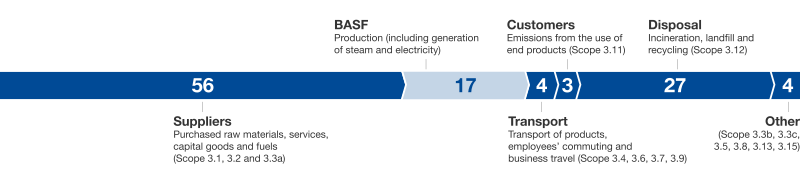
|
|
|
Retrospective |
Milestones and target years |
||||||||||||||||||||||||||||||||||||||||||
|---|---|---|---|---|---|---|---|---|---|---|---|---|---|---|---|---|---|---|---|---|---|---|---|---|---|---|---|---|---|---|---|---|---|---|---|---|---|---|---|---|---|---|---|---|---|---|
|
2025 |
2024 |
Difference 2025/2024 |
Base year |
2030 |
2050 |
Reduction each year on average |
|||||||||||||||||||||||||||||||||||||||
million metric tons of CO2 equivalents |
Financial control |
Operational controla |
Financial control |
Operational controla |
Financial control |
Operational controla |
Financial control |
Financial control |
Financial control |
Financial control |
||||||||||||||||||||||||||||||||||||
Scope 1b |
|
|
|
|
|
|
2018 |
|
|
|
||||||||||||||||||||||||||||||||||||
CO2 (carbon dioxide) |
14.063 |
13.948 |
14.402 |
14.202 |
–2% |
–2% |
17.025 |
– |
– |
– |
||||||||||||||||||||||||||||||||||||
N2O (nitrous oxide) |
0.109 |
0.109 |
0.176 |
0.172 |
–38% |
–37% |
0.667 |
– |
– |
– |
||||||||||||||||||||||||||||||||||||
CH4 (methane) |
0.023 |
0.021 |
0.027 |
0.023c |
–15% |
–9% |
0.027 |
– |
– |
– |
||||||||||||||||||||||||||||||||||||
HFCs (hydrofluorocarbons) |
0.028 |
0.028 |
0.039c |
0.038c |
–28% |
–26% |
0.091 |
– |
– |
– |
||||||||||||||||||||||||||||||||||||
PFCs (perfluorocarbons) |
0 |
0 |
0 |
0 |
0% |
0% |
0 |
– |
– |
– |
||||||||||||||||||||||||||||||||||||
SF6 (sulfur hexafluoride) |
0.001 |
0.001 |
0.001 |
0.001 |
0% |
0% |
0.000 |
– |
– |
– |
||||||||||||||||||||||||||||||||||||
NF3 (nitrogen trifluoride) |
0 |
0 |
0 |
0 |
0% |
0% |
0 |
– |
– |
– |
||||||||||||||||||||||||||||||||||||
TotalScope 1 emissions (production companies) |
14.224 |
14.107 |
14.645c |
14.436c |
–3% |
–2% |
17.810 |
– |
– |
– |
||||||||||||||||||||||||||||||||||||
Sale of energy to third parties (Scope 1)d |
1.060 |
0.922 |
0.874 |
0.746 |
+21% |
+24% |
0.773 |
– |
– |
– |
||||||||||||||||||||||||||||||||||||
Mobile emissions (Scope 1)e |
0.048 |
0.048 |
– |
– |
– |
– |
– |
– |
– |
– |
||||||||||||||||||||||||||||||||||||
Scope 1 emissions (nonproduction companies) |
0.037 |
0.038 |
0.037 |
0.038 |
0% |
0% |
– |
– |
– |
– |
||||||||||||||||||||||||||||||||||||
Gross Scope 1 emissions |
15.369 |
15.115 |
15.556c |
15.220c |
–1% |
–1% |
18.583 |
– |
– |
– |
||||||||||||||||||||||||||||||||||||
Percentage of Scope 1 emissions from regulated emission trading schemesf |
67% |
67% |
66% |
66% |
+1% |
+1% |
– |
– |
– |
– |
||||||||||||||||||||||||||||||||||||
Scope 2 |
|
|
|
|
|
|
2018 |
|
|
|
||||||||||||||||||||||||||||||||||||
Scope 2 emissions (nonproduction companies)g |
0.044 |
0.044 |
0.044 |
0.044 |
0% |
0% |
– |
– |
– |
– |
||||||||||||||||||||||||||||||||||||
Location-based Scope 2 emissions (production companies) |
3.256 |
3.408 |
3.520 |
3.587 |
–8% |
–5% |
3.747 |
– |
– |
– |
||||||||||||||||||||||||||||||||||||
Market-based Scope 2 emissions (production companies) |
1.857 |
2.008 |
2.352 |
2.416 |
–21% |
–17% |
4.067 |
– |
– |
– |
||||||||||||||||||||||||||||||||||||
Gross location-based Scope 2 emissions |
3.300 |
3.452 |
3.564 |
3.631 |
–7% |
–5% |
3.747 |
– |
– |
– |
||||||||||||||||||||||||||||||||||||
Gross market-based Scope 2 emissions |
1.901 |
2.052 |
2.396 |
2.460 |
–21% |
–17% |
4.067 |
– |
– |
– |
||||||||||||||||||||||||||||||||||||
Share of electricity consumption by market-based calculationh |
51% |
53% |
46% |
47% |
+11% |
+11% |
– |
– |
– |
– |
||||||||||||||||||||||||||||||||||||
|
|
|
|
|
|
|
|
|
|
|
||||||||||||||||||||||||||||||||||||
|
|
|
|
|
|
|
|
|
|
|
||||||||||||||||||||||||||||||||||||
Target-relevant Scope 1 and Scope 2 emissions |
|
|
|
|
|
|
|
|
|
|
||||||||||||||||||||||||||||||||||||
TotalScope 1 emissions (production companies) |
14.224 |
– |
14.645c |
– |
–3% |
– |
17.810 |
– |
– |
– |
||||||||||||||||||||||||||||||||||||
Market-based Scope 2 emissions (production companies) |
1.857 |
– |
2.352 |
– |
–21% |
– |
4.067 |
– |
– |
– |
||||||||||||||||||||||||||||||||||||
Total target-relevant Scope 1 Scope 2 emissions |
16.081 |
– |
16.997c |
– |
–5% |
– |
21.877 |
16.4 |
0 |
2.1% |
||||||||||||||||||||||||||||||||||||
|
|
|
|
|
|
|
|
|
|
|
||||||||||||||||||||||||||||||||||||
|
|
|
|
|
|
|
|
|
|
|
||||||||||||||||||||||||||||||||||||
Scope 3 |
|
|
|
|
|
|
2022 |
|
|
|
||||||||||||||||||||||||||||||||||||
Total gross Scope 3 emissions |
93.97 |
96.52 |
92.33c |
94.59c |
+2% |
+2% |
– |
– |
– |
– |
||||||||||||||||||||||||||||||||||||
1 – Purchased goods and services |
52.56 |
54.39 |
51.54c |
53.33c |
+2% |
+2% |
54.13 |
– |
0 |
– |
||||||||||||||||||||||||||||||||||||
2 – Capital goods |
1.84 |
1.82 |
1.87c |
1.83c |
–2% |
–1% |
– |
– |
– |
– |
||||||||||||||||||||||||||||||||||||
3 – Activities related to fuels and energies (not included in Scope 1 or Scope 2) |
2.49 |
2.52 |
2.81c |
2.78c |
–11% |
–9% |
– |
– |
– |
– |
||||||||||||||||||||||||||||||||||||
4 – Upstream transportation and distribution |
2.37 |
2.38 |
2.32 |
2.32 |
+2% |
+3% |
– |
– |
– |
– |
||||||||||||||||||||||||||||||||||||
5 – Waste generated in operations |
0.69 |
0.69 |
0.76 |
0.75 |
–9% |
–8% |
– |
– |
– |
– |
||||||||||||||||||||||||||||||||||||
6 – Business travel |
0.09 |
0.09 |
0.12 |
0.12 |
–25% |
–25% |
– |
– |
– |
– |
||||||||||||||||||||||||||||||||||||
7 – Employee commuting |
0.20 |
0.19 |
0.20 |
0.20 |
0% |
–5% |
– |
– |
– |
– |
||||||||||||||||||||||||||||||||||||
8 – Upstream leased assets |
0.15 |
0.15 |
0.15 |
0.16 |
0% |
–6% |
– |
– |
– |
– |
||||||||||||||||||||||||||||||||||||
9 – Downstream transportation |
1.39 |
1.43 |
1.49 |
1.53 |
–7% |
–7% |
– |
– |
– |
– |
||||||||||||||||||||||||||||||||||||
11 – Use of sold products |
2.78 |
2.78 |
3.01 |
3.01 |
–8% |
–8% |
– |
– |
– |
– |
||||||||||||||||||||||||||||||||||||
12 – End-of-life treatment of sold products |
27.17 |
27.79 |
25.67c |
26.19c |
+6% |
+6% |
– |
– |
– |
– |
||||||||||||||||||||||||||||||||||||
15 – Investments |
2.24 |
2.29 |
2.39c |
2.37c |
–6% |
–3% |
– |
– |
– |
– |
||||||||||||||||||||||||||||||||||||
Total |
|
|
|
|
|
|
|
|
|
|
||||||||||||||||||||||||||||||||||||
Total emissions (site-based) |
112.64 |
115.09 |
111.45c |
113.44c |
+1% |
+1% |
– |
– |
– |
– |
||||||||||||||||||||||||||||||||||||
Total emissions (market-based) |
111.24 |
113.69 |
110.28c |
112.27c |
+1% |
+1% |
– |
– |
– |
– |
||||||||||||||||||||||||||||||||||||
Other metrics |
|
|
|
|
|
|
|
|
|
|
||||||||||||||||||||||||||||||||||||
Biogenic CO2 emissions from the combustion or biodegradation of biomass (Scope 1)i |
0.156 |
0.156 |
0.140 |
0.140 |
+11% |
+11% |
– |
– |
– |
– |
||||||||||||||||||||||||||||||||||||
Biogenic Scope 2 emissions from the combustion of biomassi |
0.117 |
0.117 |
0.053 |
– |
+121% |
– |
– |
– |
– |
– |
||||||||||||||||||||||||||||||||||||
Biogenic Scope 3 emissions from the combustion or biodegradation of biomass in the value chaini,j |
1.49 |
1.49 |
1.26c |
1.26c |
18% |
18% |
– |
– |
– |
– |
||||||||||||||||||||||||||||||||||||
Offsettingk |
0 |
0 |
0 |
0 |
0% |
0% |
0 |
– |
– |
– |
||||||||||||||||||||||||||||||||||||
Total emissions (location-based) per sales revenue (million metric tons CO2e/billion €)l |
1.777 |
1.815 |
1.708c |
1.738c |
+4% |
+4% |
– |
– |
– |
– |
||||||||||||||||||||||||||||||||||||
Total emissions (market-based) per sales revenue (million metric tons CO2e/billion €)l |
1.754 |
1.793 |
1.690c |
1.720c |
+4% |
+4% |
– |
– |
– |
– |
||||||||||||||||||||||||||||||||||||
|
||||||||||||||||||||||||||||||||||||||||||||||
BASF reports its Scope 2 emissions using the market-based approach in accordance with the Greenhouse Gas Protocol. In 2025, the share of total electricity consumption determined in accordance with the market-based approach was 50.9%. Contractual instruments such as energy attribute certificates (Guarantees of Origin, I-RECs), also in the form of power purchase agreements, local contracts to source renewable energy and supplier-specific electricity labels are used for this purpose.
Information on methodologies, significant assumptions, factors and calculation tools that are used to calculate direct greenhouse gas emissions can be found among other places in the General Disclosures chapter of the (Consolidated) Sustainability Statement. We use emission factors from reports from the RWI – Leibniz Institute for Economic Research, the German Environment Agency and the U.S. Department of Energy, as well as supplier-specific emission factors, to calculate Scope 1 emissions resulting from the energetic use of primary energy carriers. We use supplier data where possible to calculate our market-based Scope 2 emissions. Where such data is not available, we rely on country-specific residual mix and grid-average emission factors respectively. In this case we use information from the International Energy Agency and the United States Environmental Protection Agency, among other sources. When calculating our Scope 3 emissions, we prefer to use primary data in particular for category 3.1. In the case of secondary data, we rely on leading life cycle analysis databases. The following table explains the calculation approaches used for the individual Scope 3 categories.
Scope 3 category |
Calculation methodology |
|
|---|---|---|
1 |
Purchased goods and services |
Greenhouse gas emissions from purchased chemical raw materials are calculated by multiplying the incoming volumes by cradle-to-gate emission factors. The emission factors used are either supplier-specific or regional and technology-specific values drawn from databases (industry association data, Sphera MLC, ecoinvent, etc.). Missing emission factors are estimated using internal data models or average values of similar chemicals. Emissions from packaging are calculated by multiplying the quantity of packaging purchased within a packaging group by the respective cradle-to-gate emission factor – determined on the basis of the average material composition per packaging group. Greenhouse gas emissions from technical goods and services are calculated on the basis of the monetary purchasing volume in the reporting year by multiplying expenditure (adjusted for inflation and including VAT) by the expenditure-based emission factors from DEFRA (United Kingdom Government’s Department for Environment, Food and Rural Affairs). |
2 |
Capital goods |
Greenhouse gas emissions from purchased capital goods are estimated as follows: All subareas of global technical procurement related to the procurement of capital goods are analyzed based on their monetary purchasing volume in the reporting year. Each subarea is assigned a corresponding SIC code (SIC: Standard Industrial Classification), as the expenditure-based emission factors from DEFRA are based on the SIC standard classification system. Expenditure, adjusted for inflation and including VAT, is then multiplied by the respective emission factor and added to the resulting products to calculate the total greenhouse gas emissions from capital goods. |
3 |
Activities related to fuels and energies (not included in Scope 1 or Scope 2) |
Fuel used by BASF and purchased volumes of electricity and steam are captured annually in an internal EHS database. Either supplier-specific or representative, region-specific emission factors from the Sphera MLC database are used to calculate the greenhouse gas emissions from the extraction, production and transportation of fossil fuels used to generate electricity and steam in BASF’s own power plants. The fuels used to generate purchased electricity and steam are determined either using regional statistics or site-specific values, after which the emissions are calculated in the same way as for purchased fuels. A conversion efficiency of 37% for electricity and 82.5% for steam is assumed. Greenhouse gas emissions associated with losses of purchased electricity and steam are estimated based on Scope 2 emissions and a grid-based loss factor. |
4 |
Upstream transportation and distribution |
Greenhouse gas emissions from the transportation of raw materials purchased by BASF in the reporting year are calculated by multiplying the product volumes by the respective transport distance and a corresponding emission factor. For high-volume raw materials, the means of transport and distances are specifically recorded, while an estimate is made for other raw materials. A survey conducted by the European Chemical Industry Council (CEFIC) is used for this purpose in Europe, while in other regions road transport is generally assumed. Internal transportation is calculated using the EcoTransIT World (ETW) tool. Greenhouse gas emissions from the transportation of technical goods and capital goods are determined on the basis of estimated weights and material compositions. Road transport is also assumed as the sole method for the transportation of technical goods. |
5 |
Waste generated in operations |
When determining greenhouse gas emissions from waste disposal, a distinction is made between solid waste and wastewater as well as between different disposal routes. Greenhouse gas emissions from external waste incineration with energy recovery and from recycling are assessed using the cut-off approach. Emissions from incineration without energy recovery and landfill are calculated using a carbon balance, assuming that all carbon is converted to CO2 and no methane emissions are released in landfill. CO2 emissions from wastewater are calculated on the basis of experts’ estimates from the carbon content of the wastewater. Potential nitrous oxide emissions are not taken into consideration. In the case of sewage sludge treatment, only disposal via incineration and the resulting CO2 emissions are included, assuming that the sewage sludge is not sent to landfill and therefore no methane emissions arise. |
6 |
Business travel |
Greenhouse gas emissions from business travel are recorded and calculated by the travel agents and mobility service providers commissioned by BASF. In a small number of cases, such as car rental companies, greenhouse gas emissions are determined directly on the basis of activity data using the emission factors from DEFRA (United Kingdom Government’s Department for Environment, Food and Rural Affairs). |
7 |
Employee commuting |
Emissions are determined on the basis of a survey of BASF SE employees’ commuting patterns and then estimated on this basis for all employees in Europe. For the remaining BASF regions, we use statistical data on the commuting patterns of employees. We use DEFRA and EPA (U.S. Environmental Protection Agency) carrier-specific cradle-to-gate emission factors in our calculations. |
8 |
Upstream leased assets |
This category comprises leased cars, leased office and storage space and leased equipment. Emissions from leased cars are calculated by multiplying the contractually stipulated kilometers by the relevant DEFRA emission factor, based on drive system and engine size. Since data availability varies, global emissions are extrapolated on the basis of BASF SE data and the number of staff. Greenhouse gas emissions from leased office and storage space are already covered by Scope 1 and Scope 2 emissions, if the building or warehouse is located on one of our production sites. Greenhouse gas emissions for the remaining leased office and storage space are determined on the basis of the leased space and the annual energy consumption of the relevant leased property (office or warehouse). Electricity consumption for servers leased by BASF that are not operated at our sites is provided by the relevant provider. Greenhouse gas emissions are calculated from this information using a site-specific emissions factor. |
9 |
Downstream transportation |
Greenhouse gas emissions from BASF’s freight transports are calculated as well-to-wheel (WtW) emissions using the ETW IT solution, drawing on transportation data from BASF’s ERP system. |
11 |
Use of sold products |
This category comprises direct emissions from BASF sales products’ use phase. These are products that release or form greenhouse gas emissions when used by end users. These include nitrogenous fertilizers that release nitrous oxide (N2O) through microbial activity in the soil, urea or additives for the automotive industry, residual fuels for generating energy or carbonates used in the food industry. Other products that contain and release greenhouse gas emissions include dry ice, CO2 as a gas for the beverage industry, and HFCs as a propellant for the production of polyurethane foam. We use our own sales volume data and product-specific emission factors to calculate the emissions. |
12 |
End-of-life treatment of sold products |
Sales volumes and the carbon content of BASF’s sales products are used to calculate the emissions from the disposal of BASF products at the end of their life. It is assumed that the products are disposed of in the regions in which they were sold. Regional differences in disposal routes are taken into account. The annual shares of the different disposal routes for municipal waste are taken from the following sources: Eurostat, OECDStat, China Statistical Yearbook and, where necessary, other country-specific statistics. In the case of disposal by incineration or landfill, it is assumed that all the carbon contained in the product is ultimately emitted as CO2. In the case of disposal by incineration with energy recovery, 50% of the emissions from combustion are attributed to the energy generated via a burden-sharing approach. Greenhouse gas emissions from the recycling of waste are assessed using the cut-off approach of life cycle analysis. |
15 |
Investments |
This category includes the Scope 1 and Scope 2 emissions of joint ventures and associated companies that are accounted for using the equity method and are not included in the BASF Group’s Scope 1 and Scope 2 emissions. The emissions of these companies are recorded directly using a database query or taken from publicly available emission reports. |
Internal carbon pricing
ESRS-Kennzeichnung:
We use scenario-dependent price projections to factor in the costs of CO2 emissions when assessing investment projects. In addition, these prices can also be used to evaluate research projects and to determine benchmarks. The prices differ for Europe, Asia and North America and represent the expected developments in these economic areas in the decades up to 2050. In view of the different ways in which the global economy could potentially develop, BASF currently uses three different scenarios (for more information on the scenarios, see Climate-related transition risks and opportunities), which are also used to analyze transition risks. The fundamental drivers for the scenarios are influential geopolitical actors and their various interests, different societal preferences and, building on these, climate and economic policy objectives. The result is a price per metric ton of CO2 equivalents of up to €365, depending on the year. This is used for all Scope 1 emissions caused by investments (capex) by our companies worldwide, and is included in the cost calculations. Scope 1 and Scope 2 emissions are also taken into account in the context of our target achievement. As a result, the emissions caused or reduced are directly included in the decision-making process. This favors investments in low-emission measures and measures that contribute to reducing emissions.
Since the investments will be made in the future, they are not included in the reported emissions for the business year. Consequently, the Scope 1, Scope 2 and Scope 3 emissions for the current year covered by shadow prices amount to 0 metric tons of CO2 equivalents in each case. The CO2 prices used in the Consolidated Financial Statements differ from the shadow prices described. Instead, external forecasts for CO2 prices and spot prices are used, as these enable an objective assessment on the reporting date and satisfy IFRS requirements.
26 The comparative figure for 2024 has been restated to reflect updated data.
27 Calculation basis: electricity conversion efficiency of conventional power plants 45%; steam generation efficiency 90%
28 Market-based approach, including sale of energy to third parties
29 According to the Greenhouse Gas Protocol Scope 3 standard, the term primary data refers to data that comes directly from our partners in the value chain as well as primary activity data.
30 The database values are updated on an annual basis. Significant changes in these values are reflected accordingly in our calculations.