
Sites and Business Environment
The content of this section is not part of the statutory audit of the annual financial statements but has undergone a separate limited assurance by our auditor.
The content of this section is voluntary, unaudited information, which was critically read by the auditor.
Sites and Verbund
In the 2025 business year, BASF had 108,251 employees and operated 234 production sites in 93 countries worldwide. Our aim is to serve local markets through local production. In addition to Ludwigshafen, the seven Verbund sites include the plants in Antwerp, Belgium; Freeport, Texas; Geismar, Louisiana; Kuantan, Malaysia; Nanjing, China; and Zhanjiang, China, where additional plants were commissioned and the first products from the Verbund were manufactured over the course of 2025, and commissioning of the steam cracker commenced at the end of December 2025. As planned, cracker products in accordance with specifications were made available to the processing plants in the first days of January 2026. The Verbund concept is one of our key strengths: It enables intelligent linking and steering of our plants and ensures resource-efficient, CO2-optimized and reliably managed production. From basic products to customized solutions, the core businesses are deeply integrated into long, multilevel value chains.
Business and competitive environment
As a global company, BASF is present in a large number of markets and operates under various local, regional and global conditions. These include:
- Global economic and political developments
- Legal and political requirements
- International trade agreements
- Industry standards
- Environmental agreements (such as the EU Emissions Trading System)
- Social aspects (such as the UN International Bill of Human Rights)
BASF supplies products and services to around 75,000 customers1 in almost every country in the world. Our customer portfolio comprises mainly major global customers and medium-sized enterprises. We focus on a business-to-business model and on being a partner for a wide range of downstream industries.
We work with more than 70,000 Tier 1 suppliers2 worldwide. They provide us with important raw materials, chemicals, investment goods and consumables, and perform a range of services (for more information, see S2 Workers in the Value Chain).
Our most important global competitors include Arkema, Bayer, Celanese, Clariant, Corteva, Covestro, Dow, DSM-Firmenich, Eastman, Evonik, Huntsman, INEOS, Johnson Matthey, LyondellBasell, SABIC, Sinopec, Syensqo, Syngenta, Umicore and Wanhua and many hundreds of local and regional competitors. We expect competitors from Asia, North America and the Middle East in particular to gain increasing significance in the years ahead as a result of advantageous raw materials and energy prices. BASF is a top-three market leader in over 80% of its core businesses. Equally, our standalone businesses have good to leading positions in their respective markets.
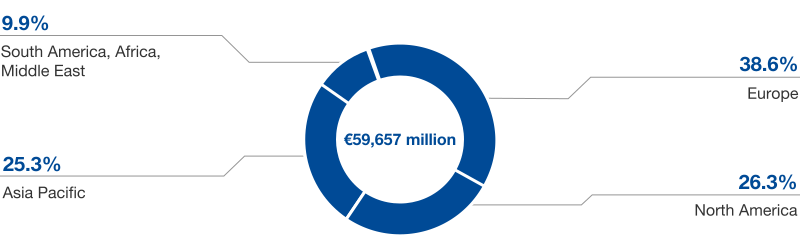
BASF sales by region 2025
By location of customer
1 The number of customers refers to all external companies (sold-to parties) that had contracts with the BASF Group in the business year concerned under which sales were generated.
2 BASF considers all direct suppliers of the BASF Group in the business year concerned as Tier 1 suppliers. These are suppliers that provide us with raw materials, investment goods, consumables and services. Suppliers can be natural persons, companies or legal persons under public law.