E3 Water
The content of this section is not part of the statutory audit of the annual financial statements but has undergone a separate limited assurance by our auditor.
The content of this section is voluntary, unaudited information, which was critically read by the auditor.
ESRS-Kennzeichnung:
Water is of fundamental importance in chemical production along the entire value chain. It is used as a coolant, solvent and cleaning agent, and to make our products. Waterways are used to transport goods. At the same time, water is a scarce commodity in an increasing number of regions. For this reason, we promote the responsible use of this resource with sustainable water management.
Our main business – the development, production and processing of chemicals – as well as the transportation of chemicals requires the responsible use of water as a resource. On the one hand, we aim to use water as sparingly and efficiently as possible. On the other hand, we want to minimize emissions of potentially harmful substances to water in our production processes and treat wastewater adequately. We address environmental, health and safety risks with a comprehensive Responsible Care Management System.
ESRS-Kennzeichnung:
As part of our double materiality assessment, the topic Water was identified as material. The assessment identified one material impact on water as a resource (see the following table).
Impact |
Evaluation |
Position in the value chain |
Description |
|---|---|---|---|
Limited availability due to water withdrawal and consumption |
Negative |
BASF’s own operations; upstream and downstream value chain |
Our activities impact water availability through water withdrawal in our own production, as well as water withdrawal and consumption along the entire value chain – particularly in water stress areas. |
The impairment of water quality through regular emissions to water is covered in the chapter E2 Pollution Prevention.
We systematically record all short and long-term opportunities and risks that arise from water as part of our general opportunity and risk management.
As the basis for the double materiality assessment, all BASF sites were considered for our own operations. We systematically record and monitor water volumes and constituents in a Group-wide database. The impacts of water withdrawal and wastewater discharge are continuously assessed and documented as part of permitting requirements. The screening of new sites also includes environmental impact assessments by independent third parties. As part of internal approval processes, risks associated with environmental impacts are assessed and documented in an environmental statement. When assessing the upstream and downstream value chain, we are aware of the risks associated with the production and handling of chemical substances and draw on our own experience.
By engaging in open and trusting dialog, we want to better understand our impact on the environment and include the perspectives of surrounding communities in our decision-making and doing. Our BASF production sites maintain close relationships with surrounding communities by providing information and updates on current developments, offering hotlines for immediate contact and availability as well as hosting community advisory panels where concerns about environmental impacts, such as water availability and quality, can be voiced (see also S3 Affected Communities). In the Civil Society Forum, founded in 2024, we exchange ideas with representatives of the civil society and trade union spectrum (for more information, see General Disclosures). Among others, cases from the area of water use have also been discussed there. In addition, we rely on dialog forums and advisory councils, such as our Nature Advisory Council, which we established together with external specialists, where we discuss topics related to nature and biodiversity (for more information, see General Disclosures).
Strategy and Governance
ESRS-Kennzeichnung:
General information on our overarching policies can be found in the General Disclosures chapter of the (Consolidated) Sustainability Statement (see Minimal disclosures on policies, actions and targets). These include, among other things, our Responsible Care Management System and, as part of this, our global standards in terms of environmental protection. BASF’s Position on Water Protection, our risk-based sustainability management for procurement and the Supplier Code of Conduct can also be found there. The specific aspects of these policies are explained in the following section.
Water protection in our production
We aim to reduce negative impacts on water availability that may be caused by water withdrawal for our own production. This requires a holistic approach and continuous control. Our water consumption is low compared with the total water volume sourced (see information on Water balance) and therefore not a material topic for BASF in terms of the double materiality assessment.
We have established Group-wide management and control systems for our own production. BASF is involved in the International Council of Chemical Associations’ (ICCA) global Responsible Care® initiative. The responsible use of water as a resource is a core element of our Responsible Care Management System, which is based on the eponymous initiative. It is also an important part of our commitment to the United Nations’ Sustainable Development Goals (SDGs). This is also reflected in our position paper on water protection. We use Responsible Care audits, including in areas such as environment (Air, Water, Waste), to monitor compliance with our Responsible Care Management System.
A key component of our strategy since 2011 has been our water target “Introduction of sustainable water management” (see Global Target). We reviewed our target in 2024 as part of the introduction of the “Winning Ways” strategy and assessed it as important for the implementation of our strategy. This is also consistent with recent scientific findings, such as the Planetary Boundaries reassessed in 2023 (Richardson et al. (2023); Stockholm Resilience Centre). We want to protect water as a resource, continuously improve water use efficiency and reduce emissions. We focus on our Verbund sites as well as on production sites in water stress areas.1 Here, we look at water availability, water quality and the impact of our water use on the environment and other users. For this, we use the standard of the Alliance for Water Stewardship (AWS) as guidance. AWS is a global multistakeholder organization that promotes the responsible use of water and of which we are a member.
Our global standards and guidelines relating to water are defined in the Group-wide requirement Corporate Requirement Environmental Protection (for more information, for example on implementation, compliance and monitoring, see E2 Pollution Prevention). These also include aspects of water management such as water use, water treatment and protection against pollution. BASF’s global network of experts shares information, insights and best practices on the responsible use of water on an ongoing basis. Our requirements and guidelines are continuously updated on a regular basis. To this end, we also exchange information with authorities, associations and international organizations.
When developing our business strategies, we also consider the resilience of our business models (for more information, see Double Materiality Assessment).
In the wake of advancing climate change, the resulting water shortages and extreme weather events, climate resilience measures are becoming increasingly important for our production (for more information on our risk management, see E1 Climate Change and details of our climate resilience measures in the area of water under Actions in our own production).
Water protection in the value chain
We are also aware of and want to mitigate the negative impacts of water withdrawal and consumption on water availability in the upstream and downstream value chains.
Upstream value chain
Our Procurement organization has established a global risk-based management system for our upstream value chain that specifies how we implement our due diligence processes (see S2 Workers in the Value Chain, Procurement guidelines). In the event of specific incidents in this context, our management processes come into effect (see S2, Evaluating and developing our suppliers and Management of specific incidents). We have set out our expectations of suppliers in the globally valid Supplier Code of Conduct (see S2, Pocurement guidelines), which also includes the responsible use of water as a resource. When selecting suppliers and evaluating supplier relationships, alongside economic criteria ESG standards are especially important. We expect our suppliers to minimize impacts on water scarcity. We arrange for third parties to evaluate suppliers with a high sustainability risk. Supplier evaluation is mainly performed as part of the chemical industry’s Together for Sustainability (TfS) initiative (see S2, Evaluating and developing our suppliers). Depending on business requirements, we perform our own Responsible Care audits at selected contract manufacturers if material risks have been identified with respect to environmental protection. This also includes the use of water.
Downstream value chain
In our downstream value chain, we continuously collaborate with our customers on innovations and the development of water-related solutions that are designed to enable their green transformation and make a significant contribution to sustainability (for more information on steering the sustainability performance of our product portfolio using the TripleS methodology (Sustainable Solution Steering), see General Disclosures). We offer our customers solutions that help purify water and use it more efficiently.
We report transparently and comprehensively on how we use water. For example, in 2025, we again participated in the program established by the nonprofit organization CDP for reporting on data relevant to climate protection with regard to the topic of water. BASF again achieved leadership status with an A- rating in the final assessment. CDP evaluates how transparently companies report on their water management activities and how they reduce risks such as water scarcity. The assessment also considers the extent to which product developments can contribute to sustainable water management also at the customers of the evaluated companies.
1 We define water stress areas as regions in which more than 40% of the available water is used by industry, households and agriculture. Our definition is based on the Water Risk Atlas (Aqueduct 4.0) published by the World Resources Institute. For more information, see wri.org/aqueduct. Our water target also continues to take into account the sites that we identified as water stress sites in accordance with Pfister et al. (2009) prior to 2019, as well as water stress sites according to Aqueduct 3.0.
Actions
ESRS-Kennzeichnung:
Our actions for the responsible use of water as a resource are often decentralized activities, projects and initiatives. They – like our management and monitoring systems – aim to ensure continuous optimization and further development and fall within the responsibility of the sites and Group companies. This goes hand in hand with the BASF approach to sustainability steering (see also General Disclosures). For this reason, we have not defined an action plan with central resource allocation for the topic Water.
Actions in our own production
An important part of our Responsible Care Management System is the continuous analysis and the implementation of actions for improvement. This can include site-based projects to improve water efficiency or wastewater quality as well as off-site measures in collaboration with third parties to improve the water situation in the catchment area.
Through our focus on operational excellence, we continuously design our plants and processes to be more efficient and resource-saving. This creates direct incentives for investments in efficiency projects.
Corresponding projects address all levels of the mitigation hierarchy: prevent, reduce, recover and reuse, restore and regenerate. The extraction, treatment, transportation and recooling of water is often associated with a high energy demand. We are constantly working to optimize our energy consumption and the amount of water we use, and to adapt to the needs of our operations and the environment.
In order to use water as efficiently as possible, we rely on measures such as intelligent cooling water systems and increased water reuse. Depending on the further use of the water (from cooling or production processes), varying levels of treatment may be required, for example using membrane filtration. When water is reused for cooling processes, it is often cooled through evaporation in recooling plants before being used again. To ensure our supply of raw materials and transportation via water, we rely on early warning systems and, at the Ludwigshafen site in Germany, for example, on special vessels for low water levels on the Rhine. Multimodal transportation concepts with combined transportation methods increase the efficiency of transportation.
Process optimizations such as the use of modified valves or the recycling of low-temperature cooling water at the General Lagos site in Argentina for example are leading to water savings. At our Verbund site in Freeport, Texas, we commissioned a membrane bioreactor for treating wastewater in 2023, which improved the capacity and cleaning performance of the wastewater treatment plant. In the medium term, the treated wastewater is to be reused, thereby reducing the need for freshwater. In 2025, the first phase of the test operation for reusage took place.
Depending on the local situation, we also implement actions together with other stakeholders. For example, at the Tarragona site in Spain, we are working with our water supplier AITASA and other companies to further expand wastewater reuse in the medium term. Through results such as reduced water use or the replacement of higher-quality water with alternative sources, our activities contribute to sustainable water management. At the Guaratinguetá site in Brazil, we have collaborated with local authorities, the Fundação Eco+ and other partners since 2011 on the Incentivo ao Produtor de Água program: Through improved soil management and the reforestation of primary forests, surface runoff and soil erosion in the Ribeirão Guaratinguetá catchment area have since been significantly decreased.
Production sites located in water stress areas are included in our target of Introducing sustainable water management (for more information, see Global Target). This also includes the implementation of actions for improvement.
Actions in the value chain
We advocate the responsible use of water as a resource along the entire value chain.
Upstream value chain
We monitor supplier compliance with environmental standards in the upstream value chain worldwide as part of our regular supplier evaluations (see S2 Workers in the Value Chain). If there is a need for improvement, we support suppliers in developing and implementing appropriate measures. We have also been involved in a wide range of initiatives to promote sustainability in the supply chain, for example since 2016 in the Pragati project for more efficient water use with regard to more sustainable farming of castor beans in India (see S2 Workers in the Value Chain).
Another example is our effort with regard to lithium sourcing. Together with BMW, Mercedes-Benz, Fairphone, Daimler Truck and Volkswagen, we were involved in the Responsible Lithium Partnership initiative from 2021 onwards. This initiative, which concluded in spring 2025, promoted the responsible use of natural resources in the Salar de Atacama in Chile. This region is home to the world’s largest lithium brine reserves and a significant share of global production. With this in mind, the German Agency for International Cooperation (GIZ) was commissioned with organizing a local multistakeholder platform, also comprising Indigenous communities, on the water-related opportunities and risks of lithium and copper extraction and other commercial activities as well as with driving forward action plans. BASF participated in a study organized by BMW together with experts from the University of Alaska Anchorage and the University of Massachusetts Amherst to examine the hydrological conditions in the Salar de Atacama. The results of this study were incorporated as an important component of the Responsible Lithium Partnership initiative’s work.
Downstream value chain
We also impact the availability of water resources in our downstream value chain through our products, solutions and their application, for example.
With TripleS, we have established a steering tool for our product portfolio based on the sustainability performance of our products (for more information, see General Disclosures). Part of the evaluation process is also water protection. For example, more efficient water use in production, new approaches to water treatment or lower water consumption are relevant here.
Agriculture is one of the highest water-consuming industries worldwide. For this reason, we develop innovative solutions for efficient water use. We work closely together with our partners to counteract increasing water scarcity.
For example, together with the International Rice Research Institute (IRRI), a research organization headquartered in the Philippines, we were able to identify water-saving practices in rice cultivation as part of the Global Carbon Field Trial Program, which was launched in 2024. The results, published in September 2025, show that direct seeding of rice instead of conventional wet rice cultivation in flooded rice fields can reduce water consumption without affecting yields. Alternate wetting & drying, as well as improved straw management for soil protection, also had a positive effect.
In the field of seed, we enable more efficient water use, for example through vegetable varieties designed for hydroponic cultivation systems. In these high-tech cultivation systems, recycling and targeted management ensure that water is used much more sparingly than in traditional outdoor cultivation.
In addition, our crop protection products support modern and precise application technologies that can help farmers significantly reduce water consumption. Digital applications provide farmers with individual recommendations for optimizing the cultivation of their crops – for example through location-specific control – and thus also contribute to water conservation.
We work with numerous partners along the value chain and from civil society to protect water as a resource, deepen our knowledge and share it with others. We are a member of the Alliance for Water Stewardship (AWS), whose 2022–2030 strategy aims for sustainable water use and promotes collective action to tackle shared water challenges. In addition, we are continuously involved in networks such as the Alliance to End Plastic Waste (AEPW), the World Plastics Council and Operation Clean Sweep® to prevent waste from plastic production from entering water bodies. In South America, we support sustainable development activities, including in the area of water, through Fundação Eco+.
Global Target
ESRS-Kennzeichnung:
Our aim is to introduce sustainable water management (for more information, see Strategy and Governance) at our Verbund sites and at all production sites in water stress areas2 by 2030, covering around 90% of BASF’s total water withdrawal. Water stress areas are identified based on the latest data on water stress areas in line with the World Resources Institute’s Water Risk Atlas.2
In 2025, we achieved 73% of our target3 (2024: 65%).4 Sustainable water management was introduced at eleven additional sites (2024: eight sites).
The focus of sustainable water management is on efficient water use, not necessarily on reducing water consumption, since the latter, compared with the total volume of water sourced, is not material for BASF in terms of the double materiality assessment. Efficient water use considers, among other things, reuse and the use of alternative or less sensitive water sources.
As part of sustainable water management, our sites regularly assess the water situation in the catchment area, particularly when changes are made to the production infrastructure, but no later than every five years. Here, we look at water availability, water quality and the impact of our water use on the environment and other users. We use the AWS Standard as guidance.5 This raises awareness of potential risks and potential impacts such as water scarcity for the population.
Our commitment to sustainable water management also extends to our value chains. We have set out our expectations of suppliers in the global Supplier Code of Conduct (see S2 Workers in the Value Chain), which, among other things, covers the areas of Responsible Care® initiative including the responsible use of water as a resource. We want to drive sustainability in the supply chain in a targeted manner and are therefore focusing on suppliers with an increased sustainability risk (for additional information, see Our Targets and Target Achievement 2025). For the downstream value chain, we use the TripleS method to aim at reducing the environmental footprint of our products, also taking into account criteria for water protection (for more information, see General Disclosures).
We discuss the sustainability topics that are material for BASF at regular meetings with external stakeholders as part of our strategic stakeholder engagement as well as in meetings with investors. Through this, the expectations of our stakeholders are continuously taken into account when setting potential targets.
2 We define water stress areas as regions in which more than 40% of the available water is used by industry, households and agriculture. Our definition is based on the Water Risk Atlas (Aqueduct 4.0) published by the World Resources Institute. For more information, see wri.org/aqueduct. Our water target also takes into account the sites that we identified as water stress sites in accordance with Pfister et al. (2009) prior to 2019, as well as water stress sites according to Aqueduct 3.0.
3 Our water target is not subject to any legally binding requirements.
4 The “Introduction of sustainable water management” water target was adopted in 2011. No site had introduced sustainable water management in the base year 2010. The target has been adjusted several times; it is not possible to adapt the comparative information for earlier periods. The number of sites relevant to the water target is reevaluated each year, so the current year corresponds to the reference year.
5 The AWS Standard (for more information, see a4ws.org) aims for the following outcomes: good water governance, sustainable water balance, good water quality, important conservation sites, and secure access to water and sanitation.
Metrics
ESRS-Kennzeichnung:
Water balance of the BASF Group in 2025
Download PDF (193 KB)Million cubic meters per year
Abstraction / supply
Water used in cooling processes
Water used in production
Total from production processes, sanitation, rinsing and cleaning in production
Discharge
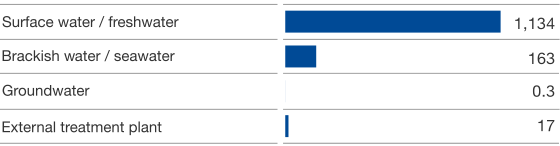
Consumption
The difference between the volume of water abstracted and the volume discharged is primarily due to the limited accuracy in measuring water discharge.
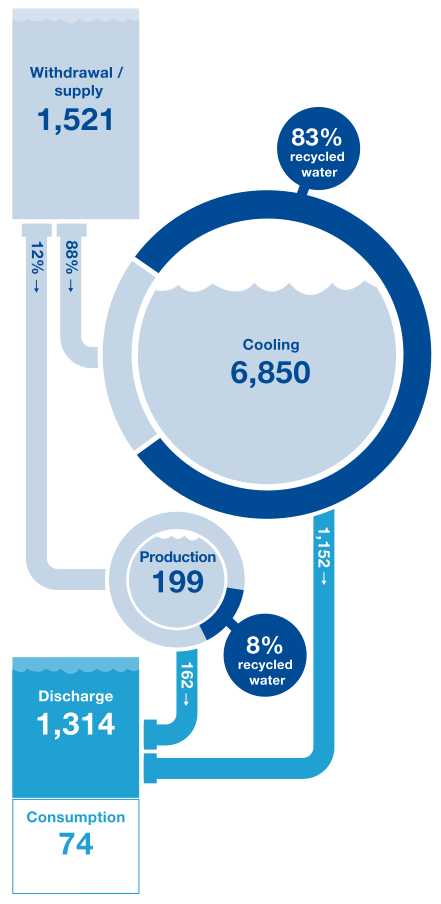
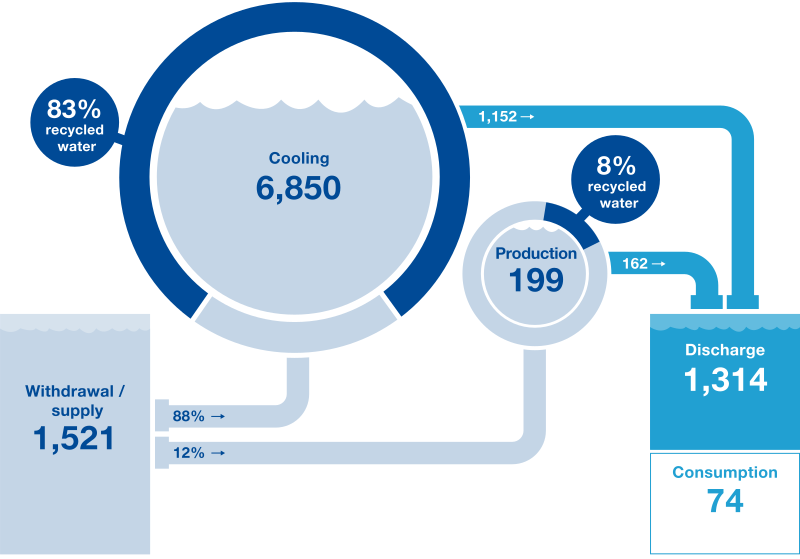
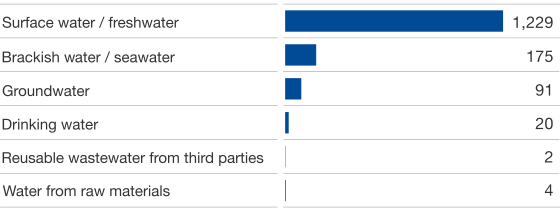
Our water withdrawal in 2025 amounted to 1,521 million cubic meters (2024: 1,507 million cubic meters). This demand was covered for the most part by freshwater such as rivers and lakes. At some sites, we use alternative sources such as treated municipal wastewater, brackish water or seawater. A small part of the water we use reaches our sites as part of raw materials and steam, or is released in our production processes.
Water use in 2025 totaled 7,050 million cubic meters (2024: 7,102 million cubic meters). The total volume of recycled and reused water in 2025 amounted to 5,714 million cubic meters (2024: 5,734 million cubic meters).
We predominantly use water for cooling purposes (88% of total water withdrawal), after which we discharge it back to our supply sources with no product contact. We reduce our water withdrawal for cooling purposes mainly by using recooling plants. Around 12% of our total water withdrawal is used in our production plants, for example, for extraction and dissolution processes or for cleaning. Here, too, we reduce our demand for water by reusing wastewater. Most of the water used for production purposes is discharged back to water bodies after being treated in our own or third-party wastewater treatment plants.
The BASF Group’s water consumption describes the amount of water that is not discharged back into a water body, meaning that it is no longer available to other users. We calculate water consumption as the sum of evaporation in cooling processes, water content in our sales products and water consumed otherwise at our sites. Consumption is mainly attributable to the evaporation of water in recirculating cooling systems. A smaller amount is from the water contained in our products. Water consumption in 2025 amounted to around 74 million cubic meters (2024: 76 million cubic meters).
In 2025, around 33% of our production sites were located in water stress areas.6 These sites accounted for 19 million cubic meters (2024: 19 million cubic meters), representing 1% of BASF’s total water withdrawal. Water consumption at these sites amounted to 8 million cubic meters (2024: 9 million cubic meters).
Production sites located in areas affected by high or extremely high overall water risk6 (23% of our sites in 2025) accounted for 14 million cubic meters (2024: 13 million cubic meters), representing 1% of BASF’s total water withdrawal. Their water consumption in 2025 amounted to 6 million cubic meters (2024: 6 million cubic meters).
A general description of our measurement methods and a description of the data collection process, as well as general information on the estimation or rounding of individual sustainability parameters, can be found in the General Disclosures section of our (Consolidated) Sustainability Statement under Sustainability Metrics.
Based on net revenue (in million €) and water consumption (in cubic meters), water intensity in 2025 amounted to 1,170 cubic meters per million €7 net revenue (2024: 1,171 cubic meters per million € net revenue).
6 Sites with high or extremely high water stress and/or overall water risk were determined based on the Water Risk Atlas (Aqueduct 4.0) published by the World Resources Institute.