
Strategy
The content of this section is not part of the statutory audit of the annual financial statements but has undergone a separate limited assurance by our auditor.
The content of this section is voluntary, unaudited information, which was critically read by the auditor.
ESRS-Kennzeichnung:
Our business
Our “Winning Ways” strategy revolves around our ambition to be the preferred chemical company to enable our customers’ green transformation (see Our Strategy). We aim to grow profitably and create value for our shareholders with our broad portfolio as well as our product and process innovations. Simultaneously, we are further developing our performance culture. We are systematically integrating sustainability topics into our strategy and business as well as into our assessment, steering and compensation systems. This principle is embedded in our corporate purpose: We create chemistry for a sustainable future.
BASF supplies products and services to around 75,000 customers from various sectors and in almost every country in the world. The majority of our customer portfolio consists mainly of large multinationals and medium-sized enterprises. Only a few of our products are marketed to end users directly. We focus on a business-to-business model and on being a partner for a wide range of downstream industries. Our operating divisions are grouped into the Chemicals, Materials, Industrial Solutions, Nutrition & Care, Surface Technologies and Agricultural Solutions segments (see Business Review by Segment).
The Chemicals segment supplies BASF’s other segments and customers with basic chemicals and intermediates. In the Materials segment, we produce advanced materials and their precursors for the plastics and processing industries. The Industrial Solutions segment develops and markets ingredients and additives for industrial applications. The Nutrition & Care segment produces ingredients for consumer applications, for example in the fields of human and animal nutrition, cleaning agents and personal care. The Surface Technologies segment offers battery materials, emissions catalysts and precious metal solutions. Agricultural Solutions is an integrated solutions provider of seeds, traits, crop protection products and digital solutions for the agricultural sector.
Our business operations focus on the chemical industry. The table BASF sales revenue in 2025 by sector lists our sales revenue by sector. Taxonomy-aligned sales revenue is presented separately under EU Taxonomy. None of our activities involve controversial weapons or exploration of fossil fuels. We supply individual solutions for tobacco cultivation via the product portfolio of our Agricultural Solutions segment. BASF has implemented global processes to ensure that products are only sold in markets where they have been approved. If a product is affected by a marketing ban or loses its approval in a particular market, the product is withdrawn from the market in accordance with local legal requirements. In general, products are phased out based on our voluntary commitments before they are impacted by bans. No products of significance for BASF were impacted by bans in the 2025 business year.
We generated sales revenue of €59,657 million in the 2025 business year (2024: €61,444 million), see Results of Operations). The following table shows the distribution of sales revenue among our customers’ sectors:
>20% |
Chemicals and plastics |
|||||
10–20% |
Transportation and automotive |
|||||
10–20% |
Agriculture |
|||||
10–20% |
Consumer goods |
|||||
<10% |
Construction |
|||||
<10% |
Electronics |
|||||
<10% |
Energy and resources |
|||||
<10% |
Health and nutrition |
|||||
|
||||||
We work with more than 70,000 Tier 1 suppliers worldwide. They supply us with important raw materials, chemicals, investment goods and consumables, and perform a range of services. More information on our supplier relationships is provided in the chapter S2 Workers in the Value Chain. An overview of our business model and inputs, outputs and impacts on our most important stakeholders, as well as of our value chain, can be found in a visual representation (How We Create Value). An overview of our workforce by region can be found in the chapter S1 Own Workforce.
Our sustainability strategy
For our customers’ green transformation (see Our Strategic Levers), we supply them with products that contribute positively to sustainability, for example through their reduced carbon footprint (see E1 Climate Change). Our transformation approach and the staggering of our transformation projects over time are explained in the E1 Climate Change chapter.
Our reported sustainability targets apply worldwide and refer to the BASF Group as a whole (for additional information, see Our Targets and Target Achievement 2025). Our strategic approach covers the entire value chain, from the responsible sourcing of our raw materials to safety and resource efficiency in production all the way to more sustainable solutions for our customers.
As part of our strategy, we are channeling our efforts into high-growth markets. For example, we want to expand our organizational structure, production sites and R&D activities in China and India. We are continuously optimizing our organizational structures, production sites and R&D activities worldwide.
Our Verbund concept1 is based on the integrated linking and steering of our plants. The Verbund creates more efficient value chains – ranging from basic chemicals to high value-added products – while enabling a more resource-efficient, carbon-optimized and reliably controllable production process. By-products from one facility are used as raw material elsewhere, for example. This saves raw materials and energy, avoids emissions, lowers logistics costs and leverages synergies. At the same time, the Verbund offers many opportunities to use renewable and recycled raw materials. Going forward, we want to better leverage this potential (see E5 Resource Use and Circular Economy).
The green transformation of our global value chain
Offshore wind farm in southern China: grid connection project completed; commissioning planned for 2026
Annual CO2 reduction of around 7,000 metric tons at the Hannibal site in Missouri by optimizing process control at our incinerators
First commercial loopamid® plant commissioned
We want to be the preferred chemical company to enable our customers’ green transformation.
Procurement of renewable and recycled raw materials
Renewable energy
Supplier management
- Code of Conduct
- Sustainability-related evaluations
- Supplier CO2 Management Program
Offshore wind farm in southern China: grid connection project completed; commissioning planned for 2026
Gradual implementation of new processes
- Feed-in of renewable, recycled and low-emission raw materials
- Emission reduction
Secure, efficient processes
- Operational excellence
- Integrated Verbund structure
- Smart technology & automation
Annual CO2 reduction of around 7,000 metric tons at the Hannibal site in Missouri by optimizing process control at our incinerators
Steering the product portfolio with the
TripleS method
- More products with sustainability benefits: Sustainable-Future Solutions
- More products that close or extend loops: Loop Solutions
First commercial loopamid® plant commissioned
Societal acceptance of our business activities (license to operate)
Sustainable steering of our product portfolio
The development of our product portfolio is a critical lever in assisting our customers with their green transformation. We particularly rely on our TripleS method (Sustainable Solution Steering) which allows us to evaluate our product portfolio’s contribution to categories such as climate change and energy, resource efficiency and circular economy. In addition to implementing new regulatory requirements, we are driving forward the adaptation and development of new production processes with the aim of reducing the environmental footprint of our products. In addition, we use our TripleS method to review the resilience of our product portfolio with regard to environmental and social aspects. The TripleS methodology is founded on clearly defined criteria that are transparently documented in the methodology manual across the respective thematic areas of sustainability (environmental, social, governance – ESG). Currently, there is no generally quantitative, scientific framework available for business-related, more sustainable steering of the product portfolio that companies could refer to when setting targets.
As part of the TripleS method, we categorize our product portfolio into five segments, taking sustainability-related aspects into account: Pioneer, Contributor, Standard, Monitored and Challenged (see graphic). Initially, we review all products to identify any current or possible future negative impacts on sustainability topics. We consider minimum standards such as the BASF Code of Conduct, hazards and chemical exposure over the entire life cycle, expected regulatory trends and reputational risks for BASF. If our portfolio assessment identifies products with sustainability concerns, we classify them either as Monitored, or in case of significant concerns, as Challenged. Products identified as having no negative impacts are reviewed to determine whether they positively contribute to at least one of the following sustainability categories: climate change and energy, resource efficiency, circularity, pollution reduction, water protection, biodiversity, zero hunger and poverty, health and safety. At the same time, the product should not negatively impact any of the other sustainability categories in a significant way. Products where neither a positive contribution to nor a negative impact on sustainability has been identified are classified as Standard. Products where a positive contribution has been identified are classified as either Contributor or Pioneer depending on their contribution level compared with the market standard. In 2025, we slightly modified and further developed the TripleS method to take account of increasingly IT-based support for assessment and regulatory changes regarding chemical safety, among other things.
Taken together, the Pioneer and Contributor products make up our Sustainable-Future Solutions. Products allocated to these segments make a positive sustainability contribution in the value chain. These include, for example, renewable and biodegradable polymers that can be used as alternatives to synthetic polymers in personal care products, and durable powder coatings that have a lower carbon footprint due to the use of renewable raw materials, among other things. We are continuing our efforts to steer our product portfolio even more toward sustainability with our “Winning Ways” strategy. By 2030, more than 50% of BASF’s sales relevant to TripleS are to be attributable to Sustainable-Future Solutions. This target was adopted by the Board of Executive Directors in 2023 based on an analysis of BASF’s portfolio and our growth forecasts (base year: 41.4%). When setting the target, we considered the startup of our Verbund site in Zhanjiang, China, for example.
Share of sales revenue generated by each TripleS segment in the 2025 business year
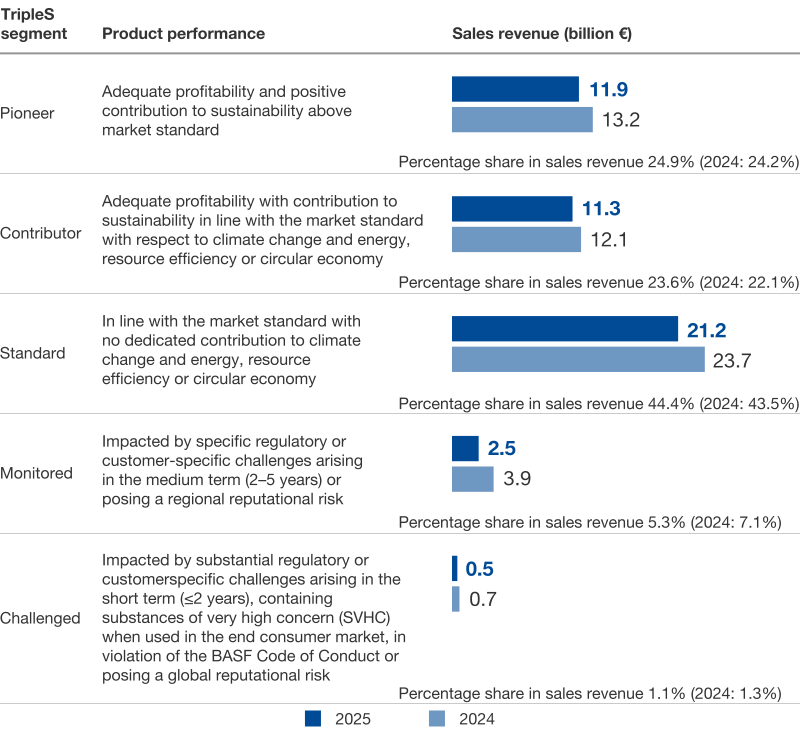
In 2025, BASF sales revenue2 from Sustainable-Future Solutions products came to 48.5% (2024: 46.3%). Despite a challenging market environment, we continue to make good progress toward achieving our set target. The Corporate Sustainability unit continuously tracks progress in this regard. These analyses are available to operating divisions and decision-makers. Any trends that are identified are recorded and documented as part of the annual operational planning process carried out by Corporate Finance. When collecting our TripleS data, we work on the assumption that we have taken all the latest relevant regulatory developments and all market developments into account. We are limited in the extent to which we are able to differentiate the positive contribution made by our products from the contribution made by competing products because the assessment is made on a qualitative basis and not on the basis of market studies. Using the TripleS method, we continuously review our relevant global product portfolio3 at least every four years. This covers around 40,000 products, taking into account the respective application and region in which the product is marketed. The portfolio relevant to TripleS comprises the sales revenue of the BASF segments from sales products sold to third parties in the business year concerned. This excludes for example business that is not product-related, such as licenses or services.
We have integrated TripleS into the assessment of our R&D processes so as to incorporate the requirements formulated by the European Commission in its Safe and Sustainable by Design framework, among other things. Our use of TripleS creates transparency regarding the contribution to sustainability made by our product portfolio and future products developed by R&D, taking circular design principles into account for example. We are reviewing the sustainability-related challenges our products are facing and we are steering our portfolio in the direction of more sustainable solutions. According to our methodology, in 2025, around €0.8 billion4 of our annual expenditure on R&D contributed to potential Sustainable-Future Solutions (2024: around €0.9 billion).
We review the effectiveness of TripleS through regular portfolio segmentation according to the method and the set target for sales with Sustainable-Future Solutions. Furthermore, we develop action plans in the case of Challenged products. These include for example research projects and reformulations to optimize products or replace them with alternatives. We are generally phasing out all Challenged products within five years of their initial classification.
1 The Verbund concept is not a BASF policy or requirement and therefore also not a policy as defined by the ESRS.
2 Of BASF’s €59.7 billion in sales in 2025, excluding the discontinued coatings business, €47.7 billion is relevant for the TripleS evaluation. By the end of the 2025 business year, we had evaluated 99.3% of the relevant portfolio. The prior-year figures include the discontinued coatings business.
3 This includes all BASF products of all A companies and some selected B companies, excluding traded goods. For more information on the Group’s legal structure, see BASF Group. The detailed definition of the relevant portfolio and further information can also be found in the TripleS method manual at basf.com/en/sustainable-solution-steering.
4 Expenditure on R&D excluding the coatings business in 2025. The prior-year figures include the discontinued coatings business.
Here you can find a comprehensive overview of the abbreviations and definitions used in the ESRS.